Common Technology Reliability Technology

Reliability Technology icon

Summary

  • Generally, reliability technology is the technology that improves product reliability by evaluating, analyzing, and understanding how product failures occur.
  • Murata's Reliability Technology consists of three technical domains: Failure Analysis Technology, Reliability Testing Technology, and Calibration Technology. By continuously advancing these technologies, it supports assurance of product characteristics and long-term reliability.
  • The strength of Murata's reliability technology lies in the trinity of these domains, where we have honed our skills specifically for the failure analysis, reliability testing, and calibration required for products. Based on precise measurement and calibration technology, we achieve quantitative stress measurement, failure reproduction, and accelerated evaluation. By combining these with various failure analysis techniques to elucidate failure mechanisms, this leads to the prevention of failures in all our products and the assurance of product characteristics.
  • The evolution of Murata's reliability technology is shifting toward proactive reliability technology that predicts failures and prevents them before they occur.

Murata's reliability technology

Technical Explanation

Murata's reliability technology consists of three technical domains: Failure Analysis Technology, Reliability Testing Technology, and Calibration Technology.

Failure Analysis Technology: This technology involves detailed examination of failure states and comparison with normal products to uncover the true failure mechanism. We possess the expertise to select the optimal methods and conditions from diverse analytical techniques to verify failure mechanisms logically inferred through Fault Tree Analysis (FTA). For example, based on accumulated knowledge from past failure cases, we select electron microscope observation conditions suited to each failure phenomenon, enabling accurate analysis for a wide variety of products.

Even for failures whose mechanisms are difficult to identify using existing techniques, we develop new in-house analytical technologies and combine them in sophisticated ways to uncover the true failure mechanism.

Reliability Testing Technology: This technology verifies whether specifications can be maintained during the anticipated market usage period through tests that apply complex stresses, such as temperature and voltage, as intended. We ensure product reliability by creating and executing reliability test programs that evaluate anticipated failure modes based on market stresses and product structure. For example, to evaluate corrosion gas resistance for products containing metal, we utilize our in-house gas corrosion testers. We manage the type and set concentration of corrosion gases according to the metal species and possess the know-how to measure gas corrosion concentrations in real environments to calculate test acceleration factors.

Calibration Technology: We select and combine standards, connectors, cables, and measuring instruments to establish unique measurement methods, ensuring strict traceability based on national standards. Furthermore, our Reliability Technology Center is a JCSS (Japan Calibration Service System) registered operator managed by NITE (National Institute of Technology and Evaluation) and complies with ISO/IEC 17025. To assure the characteristics of our unprecedented product specifications, we develop our own standards for use in calibration when calibration by external institutions is not feasible.

Three Reliability Technology Domains Supporting Murata Quality

Technological Strengths

Murata's strength in reliability technology lies in the trinity of failure analysis, reliability testing, and calibration technologies, enabling accurate evaluation of the reliability of our own products and driving quality improvement.

For example, in evaluating tin whiskers, we have established standardized methods across all company sites to ensure reproducibility of failure modes and quantitative measurement.

Specifically, we establish and execute reliability test conditions that can reproduce actual growth modes in a short time without being affected by condensation, accurately measure whisker length using electron microscopes calibrated with standards, and perform failure analysis that observes the growth state while taking electron beam-induced alteration into account. Through these efforts, we achieve highly accurate lifetime prediction. To improve reproducibility, we have also established pre-test sample preparation techniques. While it is necessary to apply thermal and humidity stress to the Sn electrode portion of the sample, excessive solder during the soldering of the evaluation substrate to the product can cover the Sn electrode portion, preventing correct evaluation. Since the reflow temperature during soldering is also specified by public standards, after assembly according to the standard, the solder wetting state is confirmed for each product. The remaining Sn electrode portion is then verified via Electron Microscope observation before conducting the Sn whisker test. Standardizing the sample pretreatment method before testing further enhances result reproducibility and quantifiability.

This technical know-how, together with rigorous procedures, has been rolled out to other sites within the company, establishing a system that delivers equivalent results even when equipment differs.

This seamless, comprehensive collaboration between reliability testing, calibration, and failure analysis technologies forms the foundation of Murata's reliability evaluation, supporting the creation of high-quality products.

Product Quality Assurance System Based on Three-Pronged Reliability Technology

Technological Advancement

Murata's reliability technology has advanced by adapting standard methodologies to products centered on multilayer ceramic capacitors (MLCCs). In recent years, product diversification, miniaturization, and increased precision, coupled with increasingly varied usage environments in the market, have made estimating failure mechanisms more difficult. To address this, it is essential to ensure the quantitative nature of measurements and to develop testing technologies with high reproducibility of failure modes. In response to these changes, failure analysis technology, reliability testing technology, and calibration technology have each evolved.

Failure Analysis Technology: This technology focuses on accurately identifying failure states inside products through cross-sectional polishing techniques. While extensive technical knowledge has been accumulated, primarily for multilayer ceramic capacitors, there was a challenge: results varied due to dependence on human perception and equipment specifications. Therefore, we have advanced the technology to quantitatively assess polishing damage during destructive analysis, design optimal conditions to reveal undamaged failure surfaces, and ensure consistent analysis results regardless of personnel or equipment.

Reliability Testing Technology: This technology ensures reliability by applying appropriate and well-controlled stress to test samples. For instance, to reduce variations in temperature and humidity stress within test chambers, we manage sample placement positions based on public standards and customer requirements to ensure stress remains within acceptable limits. Furthermore, for condensation testing, we have advanced our technology to reproduce stable condensation conditions by performing preliminary evaluations using condensation sensors and setting conditions according to the size of the sample.

Calibration Technology: This technology focuses on establishing calibration methods that minimize measurement uncertainty. Traditionally, humidity conversion using the JIS Z 8086 psychrometer involved utilizing the temperature difference between the dry and wet bulbs, which presented the challenge of high uncertainty. To resolve this, we established a method for high-precision calibration of temperature and humidity sensors. By using this method to directly calibrate the temperature and humidity inside the chamber, we have significantly reduced uncertainty.

In this way, continuously pursuing quantifiability and reproducibility in each core technology drives the shift towards “proactive reliability technology that predicts and prevents failures before they occur.” This further strengthens Murata's reliability evaluation foundation and leads to future improvements in product quality.
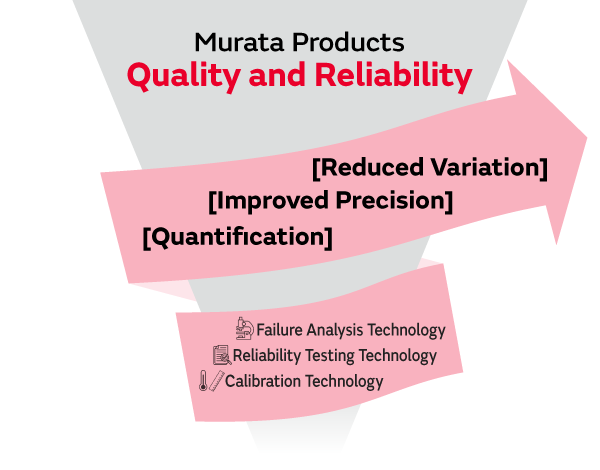
Evolution of Reliability Technology Through Pursuit of Quantifiability and Reproducibility

Application examples for this technology

This technology is applied to Murata's products and their production processes, from research and development through mass production.

Examples of Reliability Technology Application ~Product Introduction~

Technology