Create a recycling-oriented society
Basic approach
In 1994, Murata pledged “to always make sure not to make products that waste resources and energy or use production methods that destroy the environment and to strive toward coexistence with the environment.” Since then, we have proactively worked on resource conservation and recycling. To address pressure on domestic landfill capacity and to prevent soil and marine pollution caused by landfilling, we achieved zero emissions (zero waste to landfill)*1 within Japan in FY2003.
In recent years, the future risk of resource depletion has been rising in tandem with global population growth and economic development. The impact of waste incineration on climate change, together with the social impacts of resource extraction, has also become a growing concern.
To combat these issues, Murata has moved swiftly to address trends in resource circulation, promoting the transition to sustainable resources for the components and materials we use, as well as the recycling of waste generated during manufacturing—including hazardous waste—into reusable resources. Through these efforts, we are working to reduce the social impacts associated with virgin-material use, including resource depletion risks and human rights concerns, as well as the environmental impacts associated with waste disposal (including climate change).
Since FY2022, “Create a recycling-oriented society” has been selected as one of our key issues (materiality), and we have set the rate of use of sustainable resources*2 and the resource recycling rate*3 as management targets, actively advancing initiatives toward these goals. Through these initiatives, we maintain and improve natural capital with the aim of creating a recycling-oriented society.
Link: Environmental History
| Our vision for 2030 |
|
To realize a sustainable global environment through co-creation with stakeholders and to spread it to our own business and to society.
|
| Medium- to long-term goals |
| FY2027 goals |
- Rate of use of sustainable resources: 16%
- Resource recycling rate: 41%
|
| FY2030 goals |
- Rate of use of sustainable resources: 25%
- Resource recycling rate : 50%
|
| FY2050 goals |
- Rate of use of sustainable resources: 100%
- Resource recycling rate : 100%
|
| FY2025 results |
- The rate of use of sustainable resources was 15%*4, and the resource recycling rate was 39.0% in FY2025.
- Through cross-industry collaboration, we joined the first such initiative in Japan to convert industrial PET film into BHET*5, a raw material for PET.*6
- For PET-film closed-loop recycling, an industry first, we expanded processing volumes and further scaled up the system.*7
- We became the first company in the electronic component manufacturing industry to successfully establish a closed-loop recycling system for silver,*8 a key material in EMI (Electromagnetic Interference) products.*7
Link: Murata Begins Closed-loop Recycling of Silver, a Key Material of Electronic Components, a First in the Electronic Component Manufacturing Industry
- We implemented thorough waste-sorting initiatives to enable conversion into valuable resources and to reduce waste overall.*6
- To clarify priorities for our measures and accelerate our resource circulation initiatives, we have begun calculating the rate of use of sustainable resources for selected resources based on primary data provided by our suppliers.
Example (copper): annual usage of 192t; recycled material usage rate of 38%*9
|
| Current issues and initiatives |
- In order to recycle resources that cannot be handled in-house, we are building a recycling scheme, which includes technology development and verification of effectiveness, through co-creation with external partners.
- For the improvement of the rate of use of sustainable resources and the resource recycling rate, we will implement new measures while also continuing and expanding existing projects at business divisions and sites.
- We will promote the use of digital technologies and coordination with suppliers and other partners for the purpose of improving data quality.
|
- *1
This means not only eliminating waste that goes directly to landfills, but also including residue and other waste materials produced during intermediate processes. However, this excludes waste that must be landfilled to be properly disposed of.
- *2
Rate of use of sustainable resources: This indicates weight percentages of recycled materials of 24 resources with a high risk of depletion.
- *3
Resource recycling rate: This indicates weight percentages of Murata’s recycled waste (waste + valuables) resources.
- *4
This figure is an estimate, calculated using publicly available information on recycled-material usage rates.
- *5
BHET: Bis (2-hydroxyethyl) terephthalate
- *6
Initiatives that contribute to the improvement of the resource recycling rate
- *7
Initiatives that contribute to the improvement of the rate of use of sustainable resources and the resource recycling rate
- *8As a closed-loop recycling scheme for silver used as a key material in electronic components (based on Murata’s research, as of January 2025)
- *9Annual usage and recycled material usage rates were calculated based on supplier-provided data, focusing primarily on components and materials with high procurement volumes.
Risks and opportunities
| Identified risks and opportunities |
- Impact on business due to reduction in available water resources and mineral resources
- Expansion of circular economy due to waste plastic regulations, etc.
- More opportunities for sustainable procurement
|
Governance
Based on our environmental management system, Murata promotes environmental initiatives that include creating a recycling-oriented society. As part of environmental efforts, we identify risks and opportunities related to recycling and managing waste, verify legal and other requirements, implement operational controls, and conduct education and training, internal audits, and management reviews.
The Sustainability Committee, chaired by the President, and the Environmental Committee, chaired by an Senior Executive Vice President, each hold meetings twice a year to formulate policies for creating a recycling-oriented society and to report on and deliberate the progress of related initiatives.
Link: Environmental management
Strategy
Murata has long been committed not only to complying with laws and regulations but also to promoting initiatives based on the 3Rs—Reduce (minimizing waste generation), Reuse, and Recycle—including those involving hazardous waste.
While continuing these efforts going forward, we will also work on switching to recycled materials for the components and materials we use and on reducing the volume of waste sent for thermal recovery. Through these efforts, we contribute to addressing environmental and social issues, including marine pollution and climate change connected to waste and the risks of resource depletion and impacts on human rights and working environments arising from resource extraction.
By combining our technological capability—which contributes to smaller size and profile, lighter weight, higher efficiency, and longer life of components—with our manufacturing capability, which draws on sophisticated coordination of material and product development, production techniques, procurement, quality control, and manufacturing functions, we advance reductions in component and material use, the application of recycled materials, and the reuse and recycling of waste, thereby promoting the effective use of resources.
At the same time, Murata recognizes that our efforts alone have their limits. We therefore co-create with external partners to build recycling schemes and develop technologies.
What underpins these initiatives is each and every employee. Through employee training, in-house events, and other activities, we work to build awareness while also fostering a community of partners who can advance these efforts alongside us.
Use of sustainable resources
We aim not to use virgin material from 24 resources (such as Ni and Ag) corresponding to the following in our products.
- (1) Resources at high risk of depletion
- (2) Resources where stakeholders have prohibited use or have requested that use be minimized
We will conduct our business activities so that we can use resources sustainably in the future, through means such as switching to resources that do not correspond to (1) or (2) above and using recycled materials.
Resource recycling
To achieve zero emissions, Murata has been focusing on eliminating landfills and engaging in measures such as material recycling and thermal recovery (heat recovery) of waste, including hazardous waste. In recent years, in addition to eliminating landfills, we have been requested by stakeholders to use processes with a lower environmental load, for example, discontinuing thermal recovery. In consideration of these requests and social trends, we are now aiming to implement processes that will work in harmony with the rest of the world even in 2050. Toward that end, we are also engaged in "resource recycling" initiatives, where we reuse all the waste generated during our manufacturing processes as resources at our company as well as other companies.
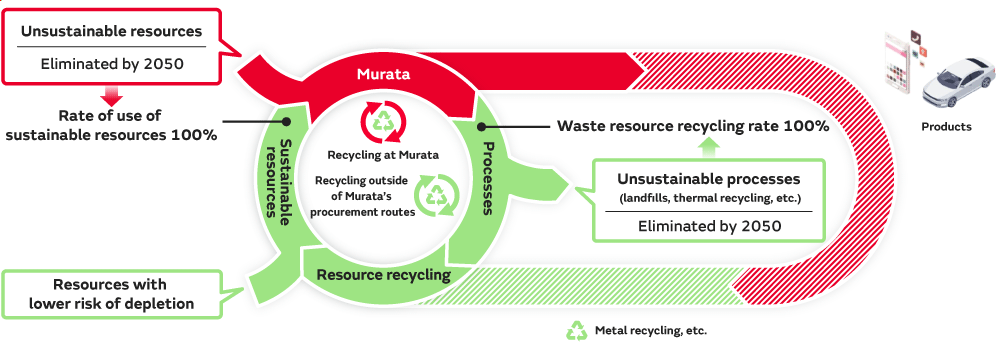 Murata's initiative towards realization of use of sustainable resources
Efforts through business processes
Zero emissions (zero waste to landfill)
In 1994, Murata pledged “to always make sure not to make products that waste resources and energy and not to use production methods that destroy the environment, and to strive toward coexistence with the environment” and has proactively worked on resource conservation and recycling. These efforts promote 3R activities and zero emissions (zero waste to landfill) to mindfully use finite natural resources and reduce environmental impact. A variety of waste is generated during our process of making electronic components, from material manufacturing to calcination and molding. We reviewed and revised the production materials and process to ensure that these waste materials are sorted and separated properly. We also encourage creating and adding recycling methods and routes in cooperation with industrial waste disposal operators. As a result, we achieved zero waste to landfill at all business sites in Japan during FY2003. In FY2024, the Murata Group achieved a global recycling rate (excluding landfills) of 98%.
First in the industry to recycle PET films in a closed-loop recycling system
In 2022, Murata became the first company in the electronic component manufacturing industry to successfully develop a system for recycling polyethylene terephthalate (PET) films used in the manufacturing of multilayer ceramic capacitors (MLCCs) and reusing them as PET films for the same purpose. Previously, used PET films for MLCCs were sent to thermal recovery or cascade recycling. This new system contributes to reducing waste and CO2 emissions as it enables cyclic use of PET materials over a long period. Additionally, we actively participated in projects that aim to achieve a “society that continuously recycles PET materials” beyond the boundary of industrial PET films in order to fulfill our responsibilities as an enterprise that uses plastic resources.
Link: Murata to Begin Closed-loop Recycling of PET Film from Multilayer Ceramic Capacitors
Link: Cross-industry collaboration in PET chemical recycling to expand sourcing of feedstocks for non-food contact materials
Participation in R PLUS JAPAN
In recent years, the impact of large-scale plastic use on climate change and the issue of marine plastic pollution have become social issues shared worldwide. To help address these issues, in 2024, Murata invested in R PLUS JAPAN Co., Ltd., which engages in projects that recycle used plastics. Sharing the company’s vision “to create a society where plastic, as a valuable resource, continues to circulate indefinitely,” Murata is contributing as a partner by drawing on the resource circulation expertise we have built up over the years, advancing the recycling of plastic materials generated at our own plants and working to introduce environmentally friendly materials.
Initiatives to reduce waste and improve resource recycling rate
Since 2021, Murata Electronics Singapore (Pte.) Ltd. has been using membrane distillation units (MDU) instead of conventional sedimentation to process plating waste liquid. The MDUs adopt new technology developed jointly with Kurita Water Industries Ltd. These units can condense waste liquid to reduce its volume to 1/60 of its original volume through a process combining reverse osmosis and membrane distillation. This process does not use any chemicals, and thus prevents entry of any foreign contaminant to the waste liquid. Intermediate waste is also recovered and reused as new products, which contributes to improving the recycle rate and promoting a circular economy.
Initiatives through products and services
Products designed with environmental impact in mind: Multilayer LCP Products
To promote the effective use of resources and contribute to reducing environmental impact throughout the product lifecycle, we have achieved the use of a 100% recycled material in the inner-layer copper foil used in our Multilayer LCP Products, which we implemented by working with our suppliers. Based on third-party verification of its status as “an environmentally friendly 100% recycled product,” this material has been certified as conforming to ISO 14021, the international standard for environmental labels that display reductions in environmental impact.
MLCC Products that Put Environmental Load Reduction into Practice Based on 'Light, Thin, Short, and Small' Characteristics
Murata has developed the technological capability that contributes to smaller size and profile, lighter weight, higher efficiency, and longer life of components, and delivered products to a wide range of markets. Notably, the development of techniques to downsize the multilayer ceramic capacitors (MLCCs) is a key achievement that responds to the needs of society, improving convenience in people’s lives and contributing to the use of sustainable resources. These developments significantly reduce materials used in products, which makes possible a more efficient use of finite resources.
Link: MLCC Products that Put Environmental Load Reduction into Practice Based on 'Light, Thin, Short, and Small' Characteristics
Environmentally-friendly packaging
Murata ships chip components on tapes wound into reels. These tapes and reels are made of materials such as paper and plastic and are disposed of as waste after use. The plastic used in these packaging materials and the environmental impact of disposing of them as waste after use have become issues to be addressed.
Murata has therefore significantly reduced the amount of packaging material used by shortening the intervals between products during packaging. For some multilayer ceramic capacitors (MLCCs), we have succeeded in reducing material usage by 50%.
In addition to reducing resources such as paper and plastic and the associated waste, this contributes to reductions in CO2 emissions and water usage, as well as improvements in production-line efficiency through fewer component replenishments.
Link: Environmentally friendly narrow-pitch taping (0201, 0402, 0603 inch sizes compatible)
Circular infrastructure P-FACTS
In the fashion world, most used apparel products are incinerated or sent to landfills, which fuels climate change and other major environmental issues. To tackle this problem, PIECLEX offers eco-friendly “electric fibers” made from environmentally friendly materials* and delivers P-FACTS, a truly sustainable fashion option whose fibers eventually biodegrade into compost that nurtures the next generation of plants. Through collaborative efforts with apparel and fiber manufacturers, we encourage making products from compostable materials.
Furthermore, based on the concept of using and reusing in the local area (“regional cyclic use”), PIECLEX collects, sorts, and composts used products in a transparent and reliable manner, ultimately using the resulting compost in agriculture and forestry.
Products are made of cotton, plastic, and other materials, with the plastic component consisting entirely of environmentally friendly material. This initiative aims to reduce the amount of apparel products incinerated or sent to landfills. It also helps reduce CO2 emissions.
<Product examples>
- PIECLEX Crew-neck T-shirt, Short Sleeves (Lightweight): 70% cotton / 30% plastic
- PIECLEX Face Towel: 87% cotton / 13% plastic
- Environmentally friendly materials refer to recycled materials and bio-derived plastics.
Link: Circular infrastructure P-FACTS for casual environmental contribution (Japanese)
Effective use of food waste: Integration of ceramic material manufacturing process technology and biotechnology
Currently, food disposal directly leads to resource waste, and greenhouse gas emissions produced during the process of disposal are causing environmental issues. To tackle these social issues, Murata is developing a technology that turns unused biomass resources, including food waste and agricultural residues, into ethanol by enzymatic reaction. We are building on high-efficiency process technologies for organic and inorganic material production cultivated through the course of our electronic components manufacturing business. We are aiming for practical application of this new technology, working in collaboration with food companies and agricultural corporations that supply unused biomass resources, as well as enterprises that use the produced ethanol.
Used-product collection and the advancement of resource circulation
The effective use of resources throughout the entire product lifecycle is an important step toward realizing a sustainable society.
Murata has established a collection and recycling system for products sold in Japan under contract and properly sorts and processes used products. Through these initiatives, we are advancing reductions in waste and in environmental impact.
Creating businesses in the Clean Tech & Green Tech field
Together with companies and local communities, we are expanding the environmental technology and expertise we have built up on the manufacturing floor across society, advancing initiatives that deliver resource circulation and decarbonization as “feasible options.”
Link: Clean Tech & Green Tech
Waste management
Proper waste management
1. In-house waste management
- Through the 3R activities (reduce, reuse, and recycle), we are continuously working on improving performance in our efforts to reduce waste and raise the recycle rate (excluding landfill use).
- Through periodic training and checking the status of waste management at each production site by means of in-group audits, we ensure proper waste sorting and storage for the prevention of accidents and compliance with laws and regulations.
2. Outsourced waste disposal management
- We visit and check the sites before entrusting waste treatment and only entrust waste handling to operators that we determined to be capable of proper waste processing. We also conduct periodic on-site inspections at the waste treatment operator’s site to make sure that proper management is maintained.
- We confirm proper disposal of released waste through their manifesto (waste management document).
3. Disaster preparedness
- If the waste treatment operator suffers damage due to a natural disaster, Murata may not be able to release waste and therefore may have to suspend production. To avert this risk, we keep multiple waste treatment routes to ensure continuity of our production activities.
Waste performance
The total amount of waste increased in FY2025 due to an increase in the production volume, but the amount per basic unit of sales remained roughly flat.
Link: Murata value report:Use of sustainable resources
Link: Third-party verification
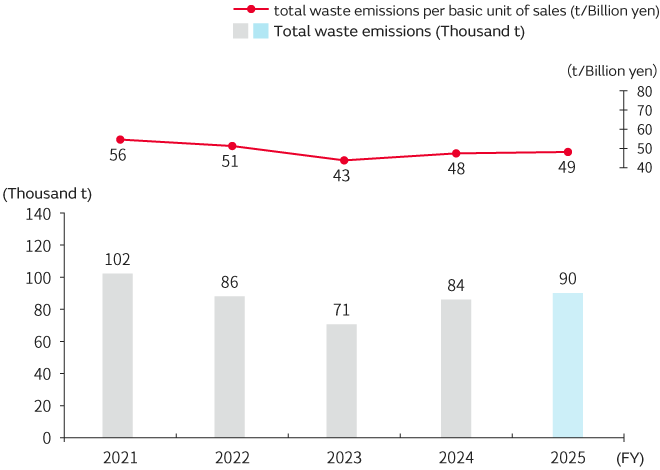 Changes in Total Waste Emissions and Total Waste Emissions Per Basic Unit of Sales
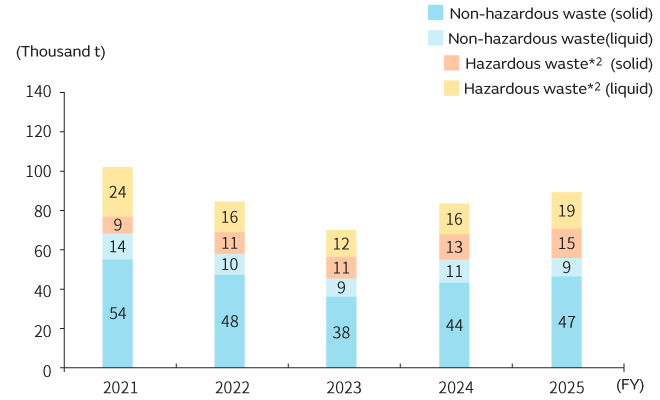 Trends in waste emissions (by type)*1
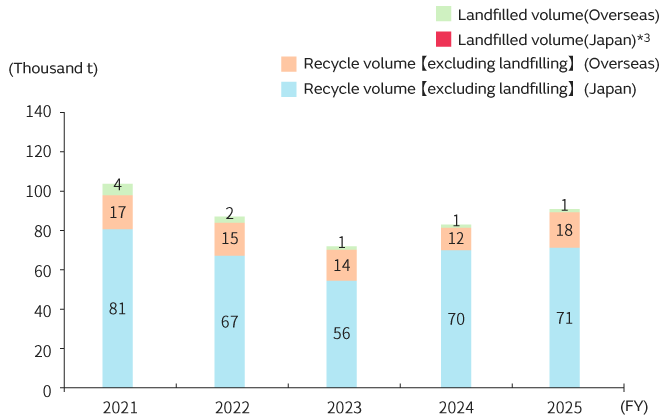 Trends in waste emissions (by method of disposal)*1
-
*1
Amounts less than the specified unit are rounded off, so the breakdown and total may not match.
-
*2
Hazardous waste: The definition varies by country. In Japan, it refers to specially controlled industrial waste.
-
*3
In Japan, Murata maintains zero landfilling since FY2003. However, this excludes waste that must be landfilled as the appropriate method of treatment.