Common Technology
Measurement Technology
(Production Process Technology)
Measurement Technology (Production Process) icon

Measurement Technology (Production Process) icon

Summary

  • Generally, measurement technology is a fundamental technology for numerically understanding and ensuring product quality and performance.
  • Murata's measurement technology consists of four pillars: electronic measurement technology, image processing technology, measurement environment control technology, and automated measurement technology. Guided by the principle that “what cannot be measured cannot be manufactured,” it comprehensively supports the reliability of electronic components.
  • From ultra-small sizes to high-performance products, we measure characteristics and shapes with high precision, at high volume, and at high speed. We reflect these results in upstream and processing stages, driving quality improvement.
  • In cutting-edge fields where existing equipment is unavailable, we collaborate with measurement instrument manufacturers. Building on this, we develop and manufacture proprietary measurement equipment in-house, constructing necessary measurement technologies from scratch.
  • We will continue advancing measurement technology. We are driving the evolution of high-precision, high-speed measurement; measurement in harsh environments; and the sophistication of measurement utilizing AI (artificial intelligence). As a foundational technology safeguarding electronic component quality, we will support the future of manufacturing.

Murata's Measurement Technology (Production Process Technology)

Technical Explanation

Murata's measurement technology is based on the principle that “what cannot be measured cannot be manufactured.”
It plays an indispensable role in ensuring the quality and performance of electronic components. This technology comprises elements of electronic measurement technology, image processing technology, measurement environment control technology, and automated measurement technology. By combining these diverse technologies, it supports product reliability.

  1. Electronic Measurement Technology: This technology measures capacitance, impedance, ESR, and other electrical characteristics of capacitors and EMI countermeasure components. It also measures frequency characteristics and S-parameters of connectivity modules and antennas. This technology accurately measures and guarantees various electrical characteristics using measuring instruments.
    Experimental apparatus for electronic measurement technology
    Experimental apparatus for electronic measurement technology
  2. Image Processing Technology: This technology uses optical systems and image processing to measure appearance and shape. It ensures dimensional and shape specifications and standards. Furthermore, it detects difficult-to-quantify items like color unevenness and shape defects, as well as minute abnormalities invisible to the naked eye, using advanced optical systems and processing algorithms.
  3. Measurement Environment Control Technology: This technology controls measurement environments to ensure accurate electrical characteristics. For example, it reproduces ultra-low temperature environments below -50°C and high-temperature, high-humidity environments for automotive products. Testing and assurance are performed under these conditions. For temperature-sensitive sensors, it achieves high-precision temperature stability control within ±1°C.
  4. Automated Measurement Technology: This technology enables efficient and high-precision operation of measurement techniques within production processes. It combines chip handling technology, which supports the alignment and transport of electronic components, with measurement fixture and terminal design technologies. It handles mass processing ranging from tens of millions to hundreds of millions of units. It enables multi-channel scanning and high-speed measurement with millisecond-level electrode contact while maintaining high precision.

Furthermore, when developing unprecedented new products, existing measurement equipment may not exist. In such cases, we collaborate with specialized measurement equipment manufacturers. Simultaneously, we develop and manufacture proprietary measurement equipment and facilities in-house, building the necessary measurement technology from scratch.

Technological Strengths

Murata's strength in measurement technology lies in its ability to measure characteristics and shapes specified in product specifications with high precision, at high volume, and at high speed. Furthermore, its ability to reliably reflect these results in the production process is another major strength.

Murata's electronic components vary widely in size, function, and characteristics. For example, even an ultra-small size like 0.4mm × 0.2mm—too small to pick up with tweezers—can cause customer circuit malfunctions if a single characteristic deviates from specifications. Therefore, even for mass-produced items, full measurement is essential to guarantee characteristics and shape.

For electrical characteristic assurance, we measure ultra-low capacitance at the pF level and ultra-low resistance at the mΩ level with an accuracy of 0.1% or less. Simultaneously, we have achieved automated measurement technology capable of conveying over 10,000 units per minute while performing 100% sorting. This utilizes circuit designs that operate measuring instruments in multi-channel configurations and employs advanced compensation software. We perform stable, high-precision, high-speed measurements while suppressing noise generated on the production line. For the jigs and fixtures that transport and measure each minute component individually, we utilize precision machining technology cultivated in-house.

For shape and dimensional assurance, visual inspection is critical. Our proprietary optical system design, algorithm design, and handling technology that stabilizes the inspection surface and transport support this precision.

Furthermore, measurement data and defect modes are accumulated in a database. This not only eliminates defective products but also feeds back trends in product characteristic variations to upstream processes.

This leads to continuous quality improvement. In this way, high-precision, high-speed measurement technology and information utilization mechanisms form major pillars supporting Murata's product quality and competitiveness.
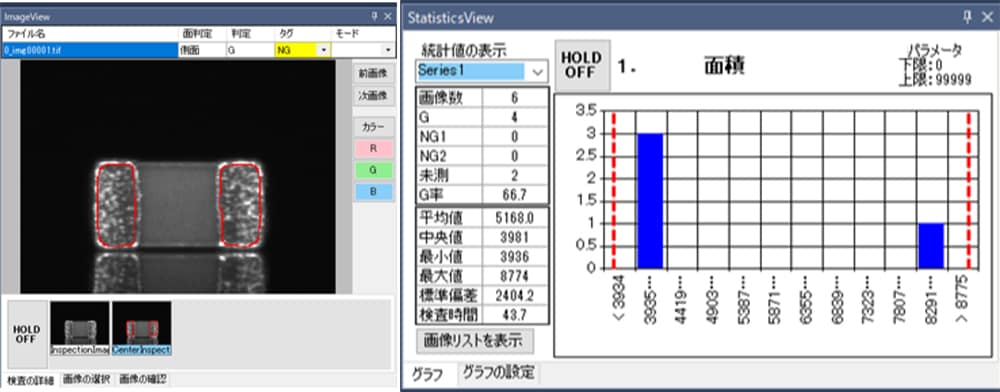
Proprietary visual inspection software

Technological Advancement

Murata's measurement technology has evolved as a fundamental technology supporting electronic component quality assurance, based on the philosophy that “what cannot be measured cannot be manufactured.”

Electronic components are becoming increasingly lightweight, thin, compact, and high-frequency. In sync with this trend, we have fused microfabrication technology with high-speed control technology to achieve measurement accuracy and speed that surpass conventional limits.

Furthermore, to respond to the exponential increase in demand, we have introduced digitalization of electronic measurement circuits, multi-channel capabilities, and high-speed probing technology. This has enabled us to progressively enhance our measurement processing capabilities.

Meanwhile, in fields demanding high quality assurance, such as automotive equipment, we have strengthened characteristic measurement technologies for harsh environments like high and low temperatures. We are also advancing image processing technologies to detect invisible micro-defects. Furthermore, we are developing defect detection technologies utilizing AI (Artificial Intelligence). These instantly extract signs of abnormalities from vast measurement data, directly linking to process improvement and quality assurance.

We will continue to evolve our measurement technologies. We will respond to the increasing sophistication of components and expanding demand. We will advance high-precision and high-speed measurement, measurement in harsh environments, and the sophistication of AI-powered measurement. As foundational technology safeguarding the quality of electronic components, we will support the future of manufacturing.

Cutting-edge technology ensuring the quality of electronic components

Application examples for this technology

This technology is applied to Murata's products and their production processes, from research and development through mass production.

Examples of Measurement Technology Application ~Product Introduction~

Technology