Materials technology Organic Materials Technology

Organic Materials Technology icon

Summary

  • Generally, organic materials technology refers to the development, processing, and application technologies for materials based on organic compounds (low-molecular-weight and high-molecular-weight) with carbon as their main component.
  • Murata's organic materials technology deploy a diverse range, from “Processing Materials Technology” that underpin production processes according to the specifications required for electronic components, to “Sub Functional Materials Technology” that keep structure and performance over the long term, and further to “Key Functional Materials Technology” that perform key functions and achieve high added value.
  • The strength of Murata's organic materials technology lies in its ability to rapidly translate electronic component requirements into optimal organic materials. This “translation” involves converting performance, reliability, process conditions, and other requirements into specific physical property values and processing processes. Murata possesses extensive knowledge regarding material factors that influence the initial characteristics and reliability of electronic components, along with their underlying mechanisms. Based on this knowledge, we can rapidly develop new organic materials tailored to emerging specifications.
  • Murata's electronic components have expanded from ceramic electronic components utilizing ceramic material functions to organic electronic components leveraging organic material functions. Consequently, organic materials technology has expanded its scope from “processing materials technology” to “sub functional materials technology.” Recently, it has evolved into “key functional materials technology,” which bears the primary functions of electronic components. Moving forward, organic materials technology will continue to evolve alongside the advancement of our products.

Murata's Organic Materials Technology

Technical Explanation

Murata's organic materials technology classifies the role of organic materials in electronic components from two viewpoints: “whether they remain within the product” and “whether they perform the product's primary function.” Based on this combination, it categorizes them into three types: “Processing Materials Technology,” “Sub Functional Materials Technology,” and “Key Functional Materials Technology.”

Processing Materials Technology: This technology improves formability during the production of electronic components, while not remaining inside the final product. Ultimately, it is a material technology that does not remain inside the product. This technology is important as an organic materials technology that supports Monozukuri behind the scenes.
For example, in the production process of ceramic capacitors, ceramic paste is coated onto a carrier film to create a green sheet. At this stage, technologies are used to select and blend dispersants for powder stabilization, select and blend rheology control agents that ensure coatability onto the carrier film, and select and blend binders and various additives to control adhesion.

Sub Functional Materials Technology: This technology does not perform the primary functions of electronic components, but remains within the product to prevent degradation under harsh environments and long-term use. This technology is a material technology for keeping the structure and function of products over the long term. It is important as an organic materials technology supporting the primary functions of electronic components.
For example, in wire-wound metal alloy power inductors, resin-coated magnetic metal powders are thermally bonded during forming to ensure adhesion between the powders. This process utilizes dissimilar material bonding technology to reliably secure the interface between the magnetic metal powders and the resin.

Key Functional Materials Technology: This technology remains inside electronic components and performs key functions that enhance product value. It is crucial as an organic materials technology possessing the primary functions of electronic components.
For example, the Multi-layer LCP product requires dielectric substrates with low dielectric constant and low dielectric loss tangent to meet high-frequency applications. A material technology meeting this requirement is the dielectric substrate forming technology using liquid crystal polymer (LCP).

Product's Primary Function
Not perform Perform
In Products Remain Sub Functional Materials Technology
- Organic Materials Technology Supporting Key Functions of Electronic Components -

[Wound Wire Metal Alloy Power Inductors, etc.]
Key Functional Materials Technology
- Organic Materials Technology with Key Electronic Component Functions -

[Multi-layer LCP product, etc.]
Not remain Processing Materials Technology
- Organic Materials Technology Supporting Monozukuri Behind the Scenes -

[Multilayer Ceramic Capacitors, etc.]

Murata's Organic Materials Technology Classification

Technological Strengths

Murata's strength in organic materials technology lies in its ability to translate electronic component requirements into optimal organic materials. This translation means converting the required performance, reliability, and process conditions demanded by electronic components into the physical properties, composition, and process conditions necessary for material selection and design.

Organic materials technology is essential for Murata's electronic components. Throughout its history, Murata has mastered various material factors and their mechanisms that influence initial characteristics, reliability, and processability. When new electronic component specifications are defined, Murata can rapidly conduct the development of the optimal organic material based on its accumulated knowledge of these material factors.

Murata's technical expertise in converting required specifications into optimal materials

Technological Advancement

Murata's electronic components have gradually expanded from ceramic electronic components utilizing the functions of dielectrics, piezoelectric materials, magnetic materials, and semiconductors, to organic electronic components utilizing the functions of organic materials. Alongside this, organic materials technology has also evolved. This evolution can be described as a shift from supporting roles to leading roles in electronic components.

Murata's organic materials technology began with processing materials technology. Taking multilayer ceramic capacitors as an example, as demands for thinner dielectric sheets and inner electrodes increased, dispersion control technology evolved into techniques ensuring dispersion and stability of finer particles. Rheology control technology advanced into techniques ensuring thinner and more uniform coating properties. Adhesion control technology evolved into techniques ensuring more precise adhesion to carrier sheets.

Next, the scope expanded to sub functional materials technology. Due to the wide variety of materials involved, heterogeneous material bonding technology has evolved beyond just ceramic-organic interfaces to include metal-organic interfaces and interfaces between different organic materials. It has also expanded into technologies for controlling the dielectric breakdown characteristics of organic materials, controlling humidity resistance reliability, and controlling environmental resistance.

Furthermore, with the advancement of the ubiquitous society, demands for wearable devices and high-frequency compatible devices are increasing. Organic materials possess functions such as dielectric and piezoelectric properties. Additionally, they are easier to process and lighter than inorganic materials. Leveraging these characteristics, the technology has evolved into key functional materials technology that controls the dielectric and piezoelectric properties of the organic materials themselves.

Moving forward, alongside the evolution of Murata's electronic components, organic materials technology will continue to advance in the fields of processing materials technology, sub functional materials technology, and key functional materials technology.
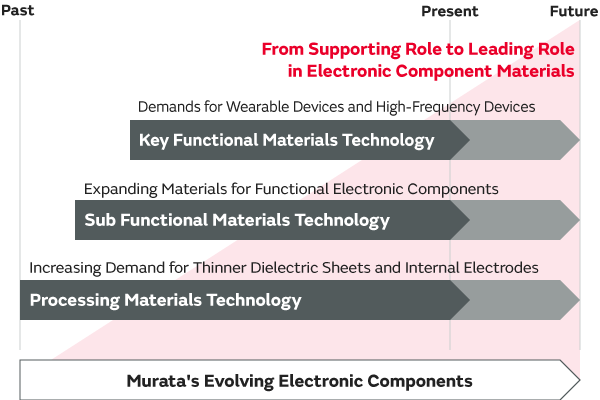
Murata's Needs and Evolution in Organic Materials Technology

Application examples for this technology

This technology is applied to Murata's products and their production processes, from research and development through mass production.

Examples of Organic Materials Technology Application ~Product Introduction~

Technology