Murata's inorganic materials technology handles diverse ceramic materials such as dielectrics, piezoelectrics, semiconductors, and magnetic materials, enabling the realization of high-performance, highly reliable electronic components through proprietary technologies.
Dielectric Material Technology: Utilizing materials such as barium titanate (BaTiO3) with high dielectric constant, it forms the dielectric layers of Multilayer Ceramic Capacitors. This layer is a critical material that determines the capacitor's capacitance and voltage withstand characteristics.
Piezoelectric Material Technology: This technology possesses the function of converting pressure or vibration into electrical signals, or converting electrical signals into mechanical vibration. Piezoelectric materials such as lead zirconate titanate (PZT) are used, with piezoelectric characteristics and temperature characteristics designed to suit the application. It provides essential functionality for applications like ultrasonic distance sensors and precision control microactuators.
Semiconductor Material Technology: Its electrical resistance changes in response to external environmental factors like temperature and voltage. It converts physical signals into electrical signals. Semiconductor ceramics (e.g., oxides for NTC (Negative Temperature Coefficient) thermistors) enable high-precision temperature measurement through precise control of material composition. They are widely used for sensing and control applications in automotive, industrial, and medical fields.
Magnetic Material Technology: Utilizes magnetic properties for energy conversion and noise suppression. Focusing on ferrite-based magnetic materials, we optimize permeability, saturation flux density, and loss characteristics for specific applications. Achieves high-efficiency power conversion and high-frequency noise reduction in inductors and EMI (electromagnetic interference) suppression filters.
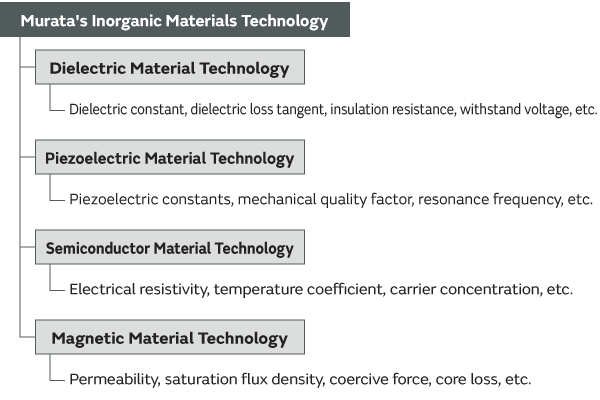 System Diagram of Murata's Inorganic Materials Technology