Murata's strength in metal material design technology lies in its ability to precisely design material compositions tailored to specific applications and performance requirements. This capability is built upon years of accumulated expertise in materials science and advanced processing and control technologies. In particular, by closely observing, analyzing, and controlling the state of metal materials from their pre-processing condition through to intermediate stages until they become final products, we refine them into materials possessing ideal performance.
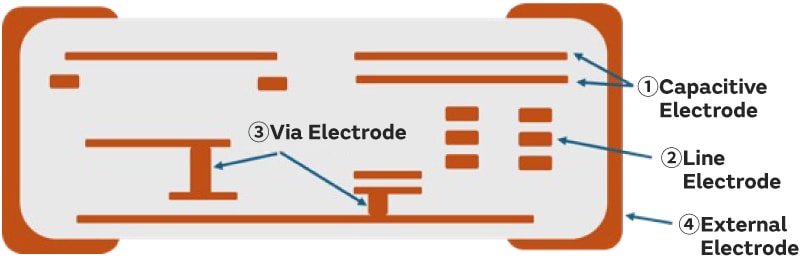
Strengths of the Technology for Unlocking the Performance of Metallic Materials: Its key strength lies in the ability to design electrodes with optimal electrical properties and high reliability for each application, leveraging our unique powder control and mixing technologies. Drawing on a wealth of knowledge accumulated over many years, we comprehensively control everything from material selection to processing conditions to maximize product performance. One example is LC filters. Within a single product, we incorporate four distinct types of copper electrodes:
- Capacitive electrodes forming the capacitor
- Line electrodes forming the inductor
- Via electrodes connecting between layers
- External electrodes connecting the product to the substrate
We adjust the design principles according to function. For instance, the capacitive electrode employs a thin, smooth design with high adhesion to glass ceramics, while the line electrode uses a narrow and thick design capable of withstanding high currents.
Since these metal materials with different functions have varying sintering temperatures, we control the process to achieve sintering at similar temperatures through composition adjustments using trace additives and surface coatings. Furthermore, electrode material design is optimized considering manufacturing process stability.
This same optimization applies not only to LC filters but to all Murata ceramic electronic components. The foundation of our technology for unlocking the full potential of metal materials lies in the collective experience and technical expertise accumulated over many years in this process.
 Technology for Unlocking the Performance of Metallic Materials
Strengths of Metallic Material–Resin Composite Technology: This technology enables the creating functions and performance unattainable with a single material. To achieve this, we thoroughly analyze material changes occurring during the manufacturing process, clarify the interface state between the metal material and the resin, and control the invisible microstructure.
A prime example is the metal alloy power inductor used in power electronics circuits. By applying heat and pressure to a composite material combining metallic magnetic powder and insulating resin, we increase the packing density and enhance performance. For high-performance magnetic cores, uniformly coating metal particles with highly reliable resin is crucial. Product characteristics degrade if the coating is too thin or too thick. We focus on resin material selection, interface control methods, and improving mixing techniques.
Leveraging our cultivated design expertise, we provide highly efficient and reliable metal composite material products.
Technology for Metallic Material Composites
Source of inserted image: Power Inductor Basic Course - Chapter 1
Technological Advancement
Evolution of the Technology for Unlocking the Performance of Metallic Materials: This technology has evolved in step with the ongoing miniaturization and increasing reliability requirements of electronic components. When Multilayer Ceramic Capacitors (MLCC) were first commercialized in 1970, the thickness of the internal electrodes was 10 to 20µm. Today, the thinnest have been miniaturized to less than 0.2µm. Furthermore, to reduce transmission loss in high-frequency bands, internal electrodes require high conductivity and surface smoothness. Consequently, internal electrode material technology continues to evolve by minimizing coarse particles and impurities and precisely controlling finer metal powders.
Additionally, reducing the environmental impact of electrode materials is an unavoidable challenge for achieving a sustainable society. We are working to utilize metal materials derived from recycled raw materials and to design electrode materials using chemicals with low environmental impact, aiming to balance performance and sustainability.
| Challenges |
Technological Advancements |
| Internal electrode thickness |
From 0–20 µm to a minimum thickness of 0.2 µm or less |
| High-frequency transmission loss |
Reduction of Coarse Particles and Impurities
Precise control of fine metal powders
|
| Reduction of environmental impact |
Utilization of metal materials derived from recycled raw materials
Electrode material design using chemicals with low environmental impact
|
Technological evolution aiming to balance performance and sustainability
Evolution of Metallic Material Composite Technology: This technology supports the advancement of metal alloy power inductors used in DC-DC converters.
Metal magnetic powders become magnetized and store energy in the magnetic field created by current, releasing it when the current decreases. However, excessive current causes increased losses and magnetic saturation, preventing sufficient energy storage. To address this, efforts have focused on suppressing magnetic saturation through adopting low-loss materials, improving surface insulation, and optimizing particle size distribution. Specifically, combining large and small particle sizes enhances packing efficiency and improves magnetic flux paths, increasing the current capacity.
Through these innovations, metal alloy power inductors have evolved into highly efficient components capable of handling large currents. As the advancement of AI (Artificial Intelligence) makes the energy consumption of electronics an increasingly critical challenge, Murata will further advance metallic materials technology for power inductors to contribute to the realization of a sustainable society.
Technology for Metallic Material Composites