Murata's electronic components have gradually expanded from ceramic electronic components utilizing the functions of dielectrics, piezoelectric materials, magnetic materials, and semiconductors, to organic electronic components utilizing the functions of organic materials. Alongside this, organic materials technology has also evolved. This evolution can be described as a shift from supporting roles to leading roles in electronic components.
Murata's organic materials technology began with processing materials technology. Taking multilayer ceramic capacitors as an example, as demands for thinner dielectric sheets and inner electrodes increased, dispersion control technology evolved into techniques ensuring dispersion and stability of finer particles. Rheology control technology advanced into techniques ensuring thinner and more uniform coating properties. Adhesion control technology evolved into techniques ensuring more precise adhesion to carrier sheets.
Next, the scope expanded to sub functional materials technology. Due to the wide variety of materials involved, heterogeneous material bonding technology has evolved beyond just ceramic-organic interfaces to include metal-organic interfaces and interfaces between different organic materials. It has also expanded into technologies for controlling the dielectric breakdown characteristics of organic materials, controlling humidity resistance reliability, and controlling environmental resistance.
Furthermore, with the advancement of the ubiquitous society, demands for wearable devices and high-frequency compatible devices are increasing. Organic materials possess functions such as dielectric and piezoelectric properties. Additionally, they are easier to process and lighter than inorganic materials. Leveraging these characteristics, the technology has evolved into key functional materials technology that controls the dielectric and piezoelectric properties of the organic materials themselves.
Moving forward, alongside the evolution of Murata's electronic components, organic materials technology will continue to advance in the fields of processing materials technology, sub functional materials technology, and key functional materials technology.
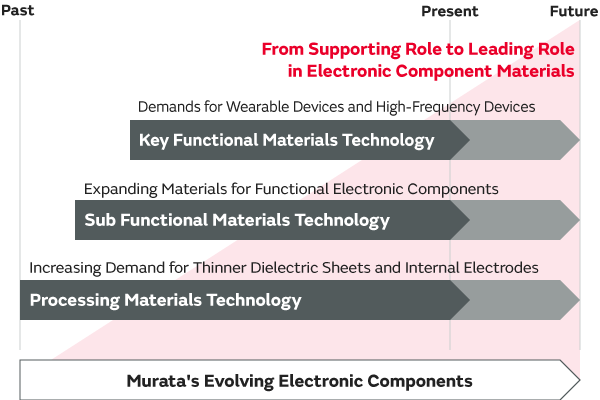 Murata's Needs and Evolution in Organic Materials Technology