Product Design Technology
Application/Solution Design Technology
(Circuit Substrate Design Technology)
Application/Solution Design Technology (Circuit Substrate Design Technology) icon

Application/Solution Design Technology (Circuit Substrate Design Technology) icon

Summary

  • General circuit substrate design technology uses CAD and CAE tools to place components on a board based on design rules and create the board layout through wiring design.
  • Murata's circuit substrate design technology is a technology for realizing our corporate Philosophy, "creating innovative products and solutions."
    It begins with investigating materials and manufacturing processes during the module product concept phase and consists of techniques that utilize CAD and CAE tools for component placement and wiring design to ensure electrical and physical performance.
  • Murata's strength in circuit board design technology lies in its adaptability to design optimal layouts by considering peripheral technologies accumulated through experience developing diverse modules for different markets.
    Murata swiftly adopts cutting-edge technologies while developing peripheral technologies, enabling early assessment of the overall manufacturing balance.
  • This established layout design technology, which incorporates peripheral technologies, underpins the competitiveness of a wide range of products, including the module product lines Murata offers for its five target markets.

Murata's Application/Solution Design Technology (Circuit Substrate Design Technology)

Technical Explanation

Murata's circuit substrate design technology is a technology for optimizing board layouts from the product concept design stage of module product development and design in order to realize our corporate Philosophy, "creating innovative products and solutions." It consists of technologies for investigating and selecting board materials and board structures to enhance product value, as well as technologies for utilizing CAD and CAE tools for component placement and wiring design to ensure electrical performance (SI, PI, EMC) and physical performance (thermal stress and mechanical stress).

Murata develops a diverse range of module products across five markets: edge devices, IT infrastructure, Mobility, Environment, and Wellness, while accumulating design technologies tailored to the characteristics of each market.
For the edge device market, Murata designs ultra-thin and high-density boards to accommodate compact devices like smartphones.

For the IT infrastructure market, Murata develops designs for base stations and other applications that balance three-dimensional structures and low transmission loss.
For the Mobility and Environment markets, Murata ensures long-term reliability for automotive devices and social infrastructure equipment by implementing component arrangement and wiring designs that adapt to installation environments and fulfill fail-safe requirements.

For the Wellness market, Murata collaborates with material technologies to secure stability for wearable devices by advancing lightweight, stretchable, and flexible board designs.

Murata's Circuit substrate design technology Tailored to Market Demands

Technological Strengths

The strength of Murata's Circuit substrate design technology lies in its ability to accommodate diverse modules tailored for different markets, achieved through layout design techniques that incorporate peripheral technologies accumulated via the development of various modules.

In addition to general printed wiring boards (PWBs), Murata's circuit substrate design technology maximizes the features of circuit substrates such as self-developed and manufactured multilayer ceramic substrates (LTCC) and multilayer LCP products, as well as advanced packaging technologies, creating the uniqueness of Murata's module products.

To achieve this, Murata uses CAE tools to analyze and verify how the physical properties of substrate materials and manufacturing processes impact the electrical and physical performance of module products. It optimizes the substrate structure (number of layers and thickness), component placement, and wiring routes based on relationships with design rules and manufacturing rules.

Moreover, by working on and utilizing cutting-edge technologies at an early stage in parallel with the development of peripheral technologies, Murata feeds back the advantages and disadvantages from the perspective of circuit substrate design to related technical departments. This approach emphasizes a balanced perspective in manufacturing practices.

Thus, the accumulation and optimization of layout design techniques that take peripheral technologies into account characterize Murata's Circuit substrate design technology and serve as a key strength supporting the competitiveness of its extensive range of module products.
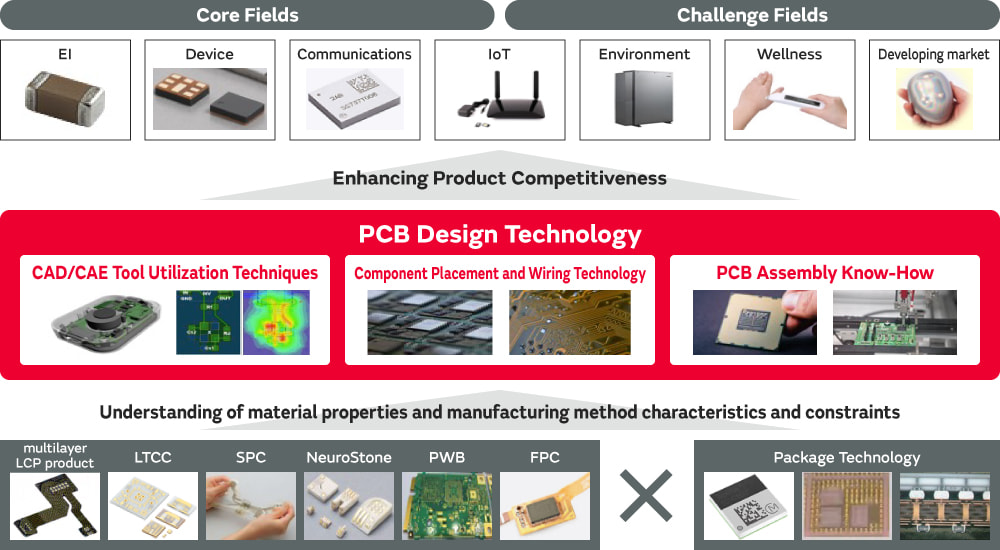
Strengths of Murata's circuit substrate design technology

Technological Advancement

Murata's Circuit substrate design technology has evolved into layout technology that enables optimized design, considering the balance of quality, cost, and performance, in line with the diversification of module products.
It began with layout technology based on the design rules for printed wiring boards and later expanded to multilayer ceramic substrates and multilayer LCP product technology.

By adapting to design rules influenced by manufacturing processes and equipment and engaging in package technologies, Murata has increased opportunities for new technology development through discussions with internal departments and supplier companies.

Moving forward, Murata's module products aim to expand into new markets and applications in addition to the current five major markets. By utilizing new materials and methods such as nanoscale materials and glass substrate multilayer technology, circuit substrate design technology is expected to contribute more significantly to enhancing product competitiveness.

Murata's Circuit substrate design technology, which excels in absorbing new technologies, accumulating layout techniques that consider peripheral technologies, and optimizing these techniques, will continue to contribute to creating module products that reflect Murata's uniqueness.

Evolution of Murata's circuit substrate design technology

Application examples for this technology

This technology is applied to Murata's products and their production processes, from research and development through mass production.

Examples of Application/Solution Design Technology Application ~Product Introduction~

Technology