Murata's precision processing technology has been cultivated since the company's founding and has evolved as the foundation of its manufacturing. Alongside the progress in miniaturization and increased functionality of electronic components, semi-finished products and jigs produced using molds have developed through repeated refinement toward finer details and higher precision.
Initially, the company relied on commercially available equipment for metal press processing and resin molding. However, as electronic components became smaller, higher precision was increasingly demanded, particularly for molds. In response, Murata established machining technology and applied it to key parts and jigs for in-house equipment. This contributed to enhancing the precision of the entire manufacturing process.
By the late 1990s, the establishment of machining technology also advanced metal press forming and resin molding techniques. Moving beyond standard commercial equipment, Murata developed specialized equipment tailored for electronic component manufacturing, achieving significant productivity gains. Entering the 2000s, challenges emerged where contact-based machining could not meet production capacity demands in fields like ceramic processing. Consequently, we introduced non-contact laser processing technology, expanding our technical capabilities.
We focused on improving shape accuracy and surface finish across each elemental technology, and today, processing at the nano-level is achievable.
These technologies have been developed early on with the core focus on transferring technical skills and know-how, utilizing CAD, CAM, and CAE. We have connected design, manufacturing, and analysis into a consistent process, driving efficiency and high quality. In recent years, we have further advanced simulation technology for machining processes in the small and micro-scale domains. By accurately predicting stresses, deformations, and thermal effects in advance, we optimize mold design and machining conditions.
Moving forward, we will advance virtual space machining process optimization through the use of sensing data and the introduction of machine learning. This will enable us to respond to the increasing sophistication and higher productivity demands of both products and the production equipment that manufactures them.
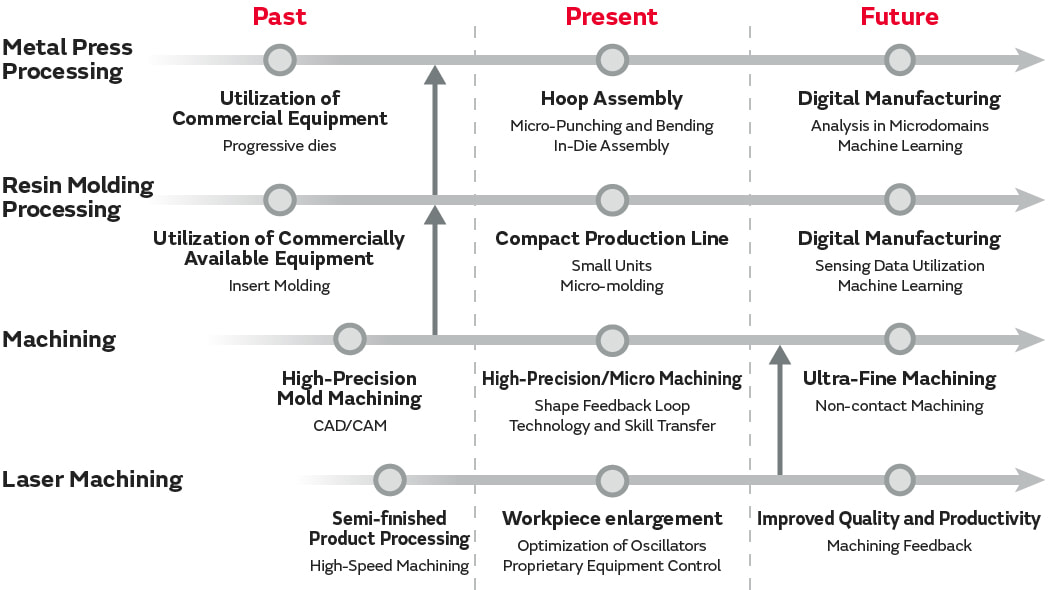 The core technological elements underpinning the evolution of Murata's precision processing technology.