Production Technology Core Equipment Technology

Core Equipment Technology icon

Summary

  • Generally, equipment technology refers to the combination of diverse technologies that support the basic functions of production equipment, ultimately materializing them as complete equipment.
  • Murata's Core Equipment Technology integrates mechanical design and control design technologies, materializing them as equipment most suited to our unique manufacturing approach.
  • The strength of Murata's Core Equipment Technology lies in its integrated collaborative framework spanning planning and design through manufacturing processes and equipment development.
  • By developing equipment for critical processes in-house, we can give shape to our unique manufacturing approach.
  • Furthermore, to achieve high quality and high productivity with our in-house developed equipment, we are evolving our elemental technologies while actively incorporating cutting-edge technologies, thereby advancing our unique manufacturing approach.

Murata's Core Equipment Technology

Technical Explanation

Murata's Core Equipment Technology integrates mechanical design and control design technologies to materialize equipment uniquely suited for its manufacturing processes.

Mechanical Design Technology: Mechanical design technology forms the foundation shaping the equipment's framework and moving parts, primarily consisting of mechanism design and analysis technologies.
Mechanism design technology ensures structures and moving components meet required performance and durability, supporting the realization of the entire device's functionality. Analysis technology performs stress and strength analysis, as well as fluid and thermal analysis. By comprehensively evaluating the safety and functionality of mechanical parts and systems, it enhances equipment reliability. CAD design technology creates 3D models before physical manufacturing, improving design accuracy and work efficiency by verifying dimensions and checking for component interference.

Control Design Technology: Control design technology is essential for achieving high-precision and stable operation of equipment and machinery, comprising multiple elemental technologies.
Circuit design technology optimizes signal transmission between hardware components like sensors and actuators, enabling accurate exchange of control signals. Image processing technology analyzes image data from visual sensors such as cameras, enabling advanced automation like anomaly detection and positioning. Programming technology constructs operational sequences and control logic using PLCs (Programmable Logic Controllers) and similar devices, supporting the development of flexible and efficient control systems.

Figure: Core Equipment Technology Relationship Diagram
Core Equipment Technology Relationship Diagram

Technological Strengths

Murata's strength in Core Equipment Technology lies in its integrated collaborative system spanning planning and design through manufacturing processes and equipment development. By developing equipment for critical processes in-house, we can bring our unique manufacturing capabilities to life.

For example, by collaborating with our Materials and Processes Division to develop proprietary exposure equipment that maximizes material characteristics, we enable wiring patterns unachievable with conventional technology, achieving superior high-frequency performance. Furthermore, by collaborating with the Product and Business Division to develop equipment specialized for positional accuracy, we ensure high reproducibility with a processing position accuracy of 3σ (sigma) = 1.4μm (micrometers) for ultra-small products requiring precision machining, enabling mass production.

Furthermore, by collaborating with the factory and Industrial Engineering (IE) departments, we have developed highly productive equipment capable of continuous processing, large-panel processing, and multi-processing. This has dramatically increased production capacity while maintaining a compact footprint.

Moreover, by collaborating with the business planning department and factories to develop equipment that allows flexible changes to processing conditions, we enable swift switching to small-lot, high-mix production and backup production across multiple sites. This creates a system that maintains stable supply even in emergencies.

These very initiatives are the source of a competitive advantage that is difficult for others to replicate. Murata will continue to develop and accumulate technologies needed for the future and those currently lacking within the company, continuously establishing highly unique equipment development and manufacturing.
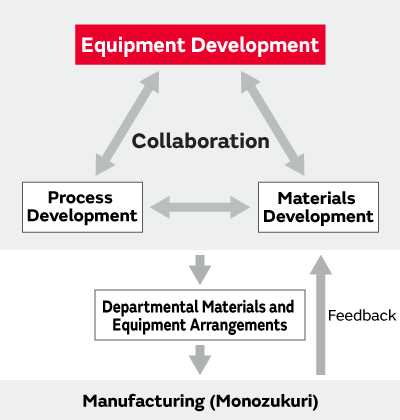
Figure: Coordination System for Core Equipment Technology Development and Related Departments
Coordination System for Core Equipment Technology Development and Related Departments

Technological Advancement

Murata's Core Equipment Technology has steadily refined its capabilities since the era of footed capacitors, guided by the principle of “establishing critical processes using in-house developed equipment.”

For example, in handling technology, positioning accuracy initially reached only several hundred micrometers. However, by combining simulation-based mechanical design with control technology and image processing-based correction techniques, we have achieved high-precision, high-speed handling at the micrometer level, capable of handling even small multilayer chip types. In assembly technology, manual fine-tuning was previously required. To enhance productivity and ensure stable quality, we developed automated assembly equipment, establishing a precise and efficient mass production system.

These achievements result from integrating mechanical design and control design technologies to evolve our entire Core Equipment Technology. Furthermore, we actively adopt advanced technologies such as real-time visualization of equipment status through IoT (Internet of Things) technology, model-based design, and digital twins.

The operational data accumulated through our in-house developed equipment constitutes invaluable assets that cannot be replicated by competitors. By integrating this data with simulation, we envision a future manufacturing paradigm where inputting product specifications and production conditions alone completes the development and design of production lines and equipment.

Figure: History of Production Equipment and Product Evolution
History of Production Equipment and Product Evolution

Application examples for this technology

*Link to the product information site.

Examples of Core Equipment Technology Application ~Product Introduction~

Technology