Examples of Technology Application ~Product Introduction~ Murata’s FORTELION Series: Pioneering Next-Generation Battery Storage Technology and Energy Management

Key Technologies Used: Battery Device Design Technology, Inorganic Materials Technology, Organic Materials Technology, Metallic Materials Technology, Application/Solution Design Technology, Surface Mount Technology, Software Technology

Image: Olivine Type Lithium Iron Phosphate Lithium Ion Secondary Battery (FORTELION)

Summary

  • Murata’s FORTELION is a cylindrical lithium-ion secondary battery that uses olivine-type lithium iron phosphate, LiFePO4 (lithium iron phosphate), as its cathode material.
    FORTELION is characterized by high safety and long service life, backed by more than 15 years of proven market performance.
  • The 24 V battery module combines multiple cells with a Battery Management Unit (BMU) that provides voltage monitoring, temperature monitoring, and protection control functions.
    This configuration makes the module ideal for applications such as AGVs (Automated Guided Vehicles) and robots.
    Energy Storage Systems (ESS) using FORTELION enable efficient utilization and stable supply of renewable energy in residential, commercial, and industrial applications.
  • The FORTELION series continues to evolve with safety as its core principle, while incorporating modularization technologies, IoT (Internet of Things) connectivity, and future-oriented AI (Artificial Intelligence) utilization and grid integration.
    Through these efforts, Murata contributes to reducing environmental impact and realizing a sustainable society.

Murata's FORTELION

Product Description

Murata’s FORTELION is a cylindrical lithium-ion secondary battery that employs olivine-type lithium iron phosphate as its cathode material.
More than 15 years of market use have demonstrated its high safety and long service life.
The battery incorporates internal safety mechanisms such as a thermal management structure and a gas venting mechanism, which reduce risks under abnormal conditions.
In addition, optimization of the separator and electrolyte enhances durability and discharge performance.

The FORTELION 24 V battery module combines multiple FORTELION cells with a BMU equipped with voltage monitoring, temperature monitoring, protection control, and status indication functions.

An ESS (Energy Storage System) stores and optimally controls electric power, and is suitable for residential, commercial, and industrial applications.
From cells to modules and systems, Murata carries out integrated domestic production, ensuring high quality and stable supply through rigorous quality control.

Olivine Type Lithium Iron Phosphate Lithium Ion Secondary Battery (FORTELION)
FORTELION 24V Battery Module
FORTELION Battery System

Product Strengths

The key strengths of Murata’s FORTELION are its high safety and long service life.
Lithium iron phosphate has a low risk of thermal runaway and delivers stable performance even under harsh conditions.
Its long service life reduces maintenance costs and also contributes to lower environmental impact.

The All-in-One type 24 V battery module offers dustproof and waterproof performance equivalent to IP54.
It supports 2C charging at 42 A (ampere) and enables inter-module connection via CAN communication, enhancing system scalability and flexibility.
This allows use in a wide range of applications, including AGVs and robots.

ESS products have more than 10 years of market experience. Murata continues to provide maintenance and support services while staying close to users, resulting in many successful deployments.

High Safety
The crystalline structure is thermally stable, and thermal runaway does not occur even in cases of overcharging or internal short circuits.
Long life (Calendar)
*Expected life of 15 years or more
Long life (Cycle)
The solid and stable crystalline structure ensures gradual capacity degradation even after repeated charge–discharge cycles.
Long life (Float Charging)
Capacity deterioration is gradual even in the float charging state.(the condition when stored with charging voltage applied).

Source of inserted image: Olivine Type Lithium Iron Phosphate Lithium Ion Secondary Battery (FORTELION)Open the New Window

Product Evolution

Murata’s FORTELION series has evolved with a strong focus on safety.

Conventional lithium-ion secondary batteries offer high energy density but face challenges such as thermal runaway and performance degradation due to aging.
To address these issues, Murata leveraged its long-cultivated advanced materials technologies and cell design expertise.
By adopting olivine-type lithium iron phosphate as the cathode material, Murata developed FORTELION, achieving enhanced safety performance through thermal management structures and gas venting mechanisms, as well as improved durability through an optimized separator and electrolyte.
The addition of modularization technology significantly improved design flexibility and operational efficiency.
For ESS products, Murata is enhancing advanced system control and smart energy management functions through IoT integration.
Looking ahead, Murata is also exploring AI-based optimal operation and grid integration.
At the same time, Murata continues to advance material selection and manufacturing process improvements with environmental considerations in mind.
Through these initiatives, Murata contributes to the realization of a sustainable energy society.

Figure: Comparison of capacity degradation with conventional lithium-ion secondary batteries
Comparison of capacity degradation with conventional lithium-ion secondary batteries

Product Applications

Murata’s FORTELION is a lithium-ion secondary battery that combines high safety with long service life, supporting a wide range of applications including industrial, residential, and emergency use.
In the industrial sector, it is used in AGVs, robots, forklifts, and other equipment, contributing to factory automation and logistics efficiency.
It is also utilized in residential energy storage systems, solar power generation systems, and backup power supplies during outages, supporting the stable supply of renewable energy.
Application examples include RE100-compliant solar co-installation systems, residential storage systems, and emergency power supplies that have obtained battery equipment type certification at the single-cell level.

Furthermore, the modular configuration can be customized, allowing easy adjustment of voltage and capacity to suit specific applications and enabling flexible responses to diverse industrial needs.
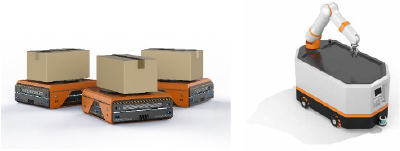
Image: Examples of lithium-ion secondary battery applications in the industrial sector
Examples of lithium-ion secondary battery applications in the industrial sector
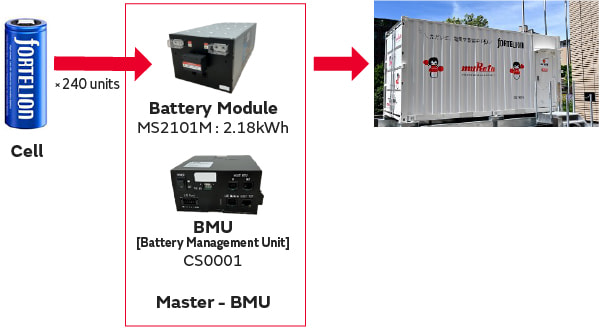
Image: Major implementation examples: large-scale systems
Major implementation examples: large-scale systems

Other Practical Examples ~Product Introduction~

Technology