Heat-resistant ceramic catalysts are a technology that aims to maintain performance even in high-temperature environments through a structure and material design that differ from conventional catalysts. Achieving this involves overcoming development difficulties and using ingenuity.
Sato: "Conventional catalysts typically have a structure in which nanoparticles of platinum and other precious metals are placed on the surface of a base material. However, when heat is applied, these nanoparticles migrate due to the heat and thus the surface area decreases due to agglomeration. This led to the issue of a decline in reactivity. Murata designs catalysts as a composite material mixed with the base material at the atomic level, rather than placing nanoparticles on the base material.
Traditionally, Murata's material design for electronic components has involved controlling the electrical properties by substituting the elements in the crystal structure. Applying this technology and substituting the active elements in the crystal structure of the base material has allowed us to be able to maintain their properties as catalysts, even when high heat is applied. We believe that this precious metal-free design also eliminates the risk of price fluctuations and as a consequence, offers the benefit of stable procurement costs.
A point that has been difficult in the development process up to now has been the matching of a technology with its application. We were able to successfully utilize our technology precisely because it is an exhaust gas treatment system that operates at high temperatures like an RTO. However, this technology cannot be applied to all catalytic reactions. I think we were able to arrive at this result only because we repeatedly developed materials and explored applications with the cooperation of our customers, university professors, and various other stakeholders based on the target of reducing GHGs."
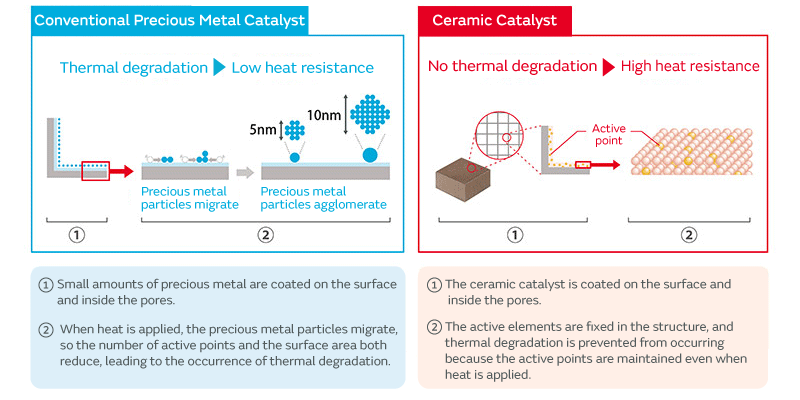 Murata's Unique Material Technology: Precious Metal-Free × High Heat Resistance
Yasuda: "In fact, we tested the catalyst in small treatment devices during the initial development. This was a small in-house trial of a size in which about one or two honeycomb-shaped catalysts fitted into a single unit. However, we thought that as we were making the effort to conduct a trial, it would be better to use a larger treatment device. That led us to RTOs that use several hundred to 2,000 honeycombs per unit.
RTOs themselves have been adopted in many factories as relatively energy-efficient devices. Even so, annual fuel costs range from several million to tens of millions of yen. There are also more than a few factories that emit several hundreds of tons of greenhouse gases per year from their own operations.
Therefore, we have received a lot of feedback from customers saying that they would like to try utilizing heat-resistant ceramic catalysts if doing so makes it possible to reduce fuel use and GHG emissions. In particular, we have received inquiries from those who would like to utilize these catalysts at high temperatures and those who want to utilize them in overseas factories in addition to those in Japan."
We will hear about demonstration data from Japan and China, as well as aspirations for the future, in Part 2.
Continue reading:
Murata Manufacturing's Heat-Resistant Ceramic Catalysts Significantly Reduce Fuel Use: Taking on the Challenge of Reducing Scope 1 Emissions (Part 2)