Murata uses globally-recognized tools such as WRI Aqueduct*2 and Water Risk Filter*3 to evaluate water risks. Our screening process determined that the majority of our business sites have a low-to-medium water risk.
In order to set CBWTs*4, which are water management goals based on regional characteristics and catchment context, we evaluated the water supply and demand balance based on factors such as demographics in watershed areas around 11 key business sites accounting for 70% of the water used throughout the entire group, and also took biodiversity into account in evaluating possible impact on key biodiversity areas (KBAs).
As a result, we found relatively high water risk (water stress) at four business sites in Thailand, the Philippines, and Wuxi and Foshan in China. For these four business sites, we establish a risk mitigation policy and are working on risk avoidance.
In addition, when acquiring land for building a new plant, we review water resource availability and check for risks such as effluent regulations.
We will continue our efforts in monitoring water risks in different areas and improving water usage for more efficient water use.
-
*2
: Water risk evaluation tool developed by the World Resources Institute (WRI)
-
*3
: Water risk analysis tool developed and operated by the World Wide Fund for Nature (WWF), an international non-governmental organization working on environmental conservation
-
*4
: Context-based Water Target (CBWT)
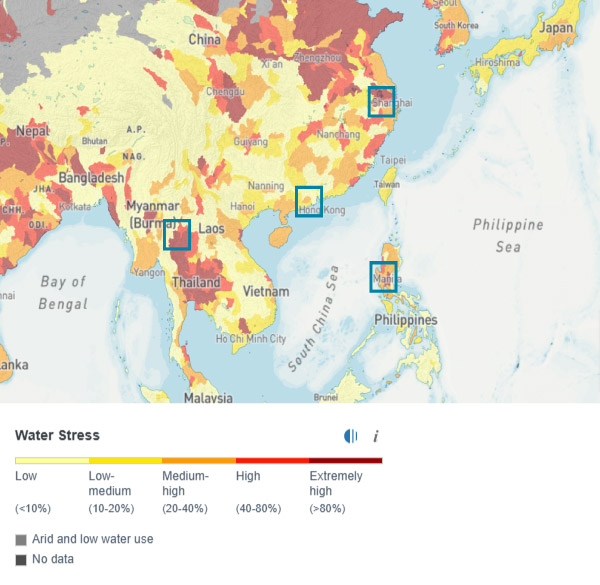 Mapping of business sites with high water stress levels (Source: Aqueduct
 )
)