Murata conducted demonstration experiments in our own factories to verify the performance of our heat-resistant ceramic catalysts in a real-world environment. We spoke with Mr. Yasuda from the Ceramic Capacitor Business Unit and Mr. Sato from the Corporate Technology & Business Development Unit about the demonstration process and the specific results obtained from it.
Yasuda: "First, we wanted to test our catalysts, starting with sites that consume a lot of fuel, in order to demonstrate the technology at Murata's factories. Accordingly, our production site in Wuxi, China became a potential test site. There are strict regulations on exhaust gas treatment in China. Therefore, successful results in China would provide powerful data for global rollout of the catalysts. Together with this, we also felt it was essential to conduct a test in an environment where we could easily obtain detailed data. That meant we also conducted a demonstration at our Yasu Division in Shiga Prefecture. This is a site that is physically close to Murata Manufacturing's headquarters.
In the demonstration, we installed our heat-resistant ceramic catalysts and then gradually lowered the set temperature. We confirmed that there were no problems with the decomposition performance when lowering the temperature by 50℃, 100℃, and then 150℃. We expected a fuel reduction effect of about 20 to 30% in our preliminary calculations. However, we actually produced results that far exceeded our expectations, with a fuel reduction effect of 30 to 50% and, at most, of more than 60%.
We couldn't believe the results at first, so we conducted repeated detailed analysis. This was because we predicted a reduction effect of just a few tens of percent, based on our simple preliminary calculations when lowering the set temperature from 850℃ to 700℃. Nevertheless, upon investigation, it became clear that, in reality, the exhaust gas concentration constantly fluctuates according to the factory's production volume, causing the burners to repeatedly open and close in line with those fluctuations. Therefore, introducing catalysts stabilizes the heat inside the furnace, and this reduces the need for the burners to open and close. As a result, this helped the fuel reduction rate as a synergistic effect.
In terms of the actual fuel reduction after introducing the catalysts, the technology demonstrated an energy-saving effect of 53% at Yasu Division A, 32% at Yasu Division B (separate line), and 37% at Wuxi Murata Electronics Co., Ltd. We also produced an energy-saving effect of 62% at Izumo Murata Manufacturing by combining an existing heat storage unit and catalysts without changing the set temperature. This corresponds to an annual reduction in GHGs of 2,000 tons."
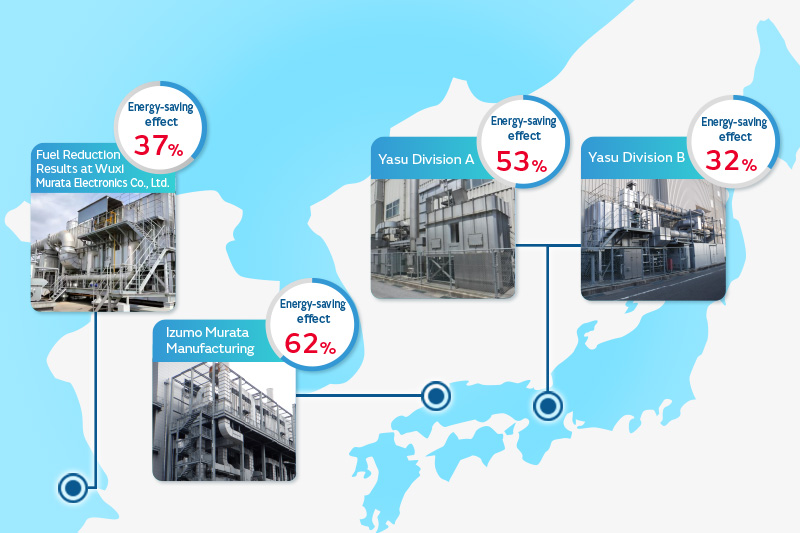 Fuel Reduction Results at Wuxi Murata Electronics Co., Ltd., Izumo Murata Manufacturing, Yasu Division A, and Yasu Division B
Sato: "Even when we show customers the demonstration figures, they often ask us, 'Why does this happen?' As engineers, I believe we need to consider how to explain the effects in an easy-to-understand manner from the perspective of the actual user."