Common Technology Simulation Technology

Simulation Technology icon

Summary

  • In general, simulation technology virtually reproduces real-world phenomena and processes on a computer. This supports optimization and problem-solving in design, manufacturing, and operation.
  • Murata's simulation technology numerically analyzes complex physical phenomena in the development, manufacturing, and service provision of electronic components. It enhances development efficiency and product reliability through design optimization, durability evaluation, and manufacturing process improvement.
  • A core strength of Murata's simulation technology lies in its in-house developed CAE (Computer-Aided Engineering) software, “Femtet.” By involving field engineers in the improvement process, it enables high-precision and rapid analysis tailored to solving specific challenges.
  • Since initiating in-house software development in 1982, it has continued to evolve. The scope of analysis has expanded to cover diverse fields such as magnetic fields, thermal phenomena, and fluid dynamics, integrating intuitive operability with AI utilization. By combining field expertise with cutting-edge technology, it constantly strives for further advancement.

Murata's simulation technology

Technical Explanation

Murata's simulation technology accelerates product development by representing complex physical phenomena as numerical models and analyzing them on a computer. It employs diverse methods such as the finite element method and multiphysics analysis, covering everything from material microstructures to the macro performance of products. These capabilities enable shape optimization, durability evaluation, and prediction of thermal and vibration behavior during the design phase, thereby reducing the cost and time associated with prototyping and experimentation.

Furthermore, by simulating molding and processing steps in the manufacturing process, the technology helps reduce defects and improve production efficiency. These technologies are used across a wide range of areas, from material development and product design to production engineering, directly contributing to higher product performance and improved reliability.

Looking ahead, Murata will continue to integrate cutting-edge analysis methods and computational techniques, working closely with field engineers to further advance its simulation technology.
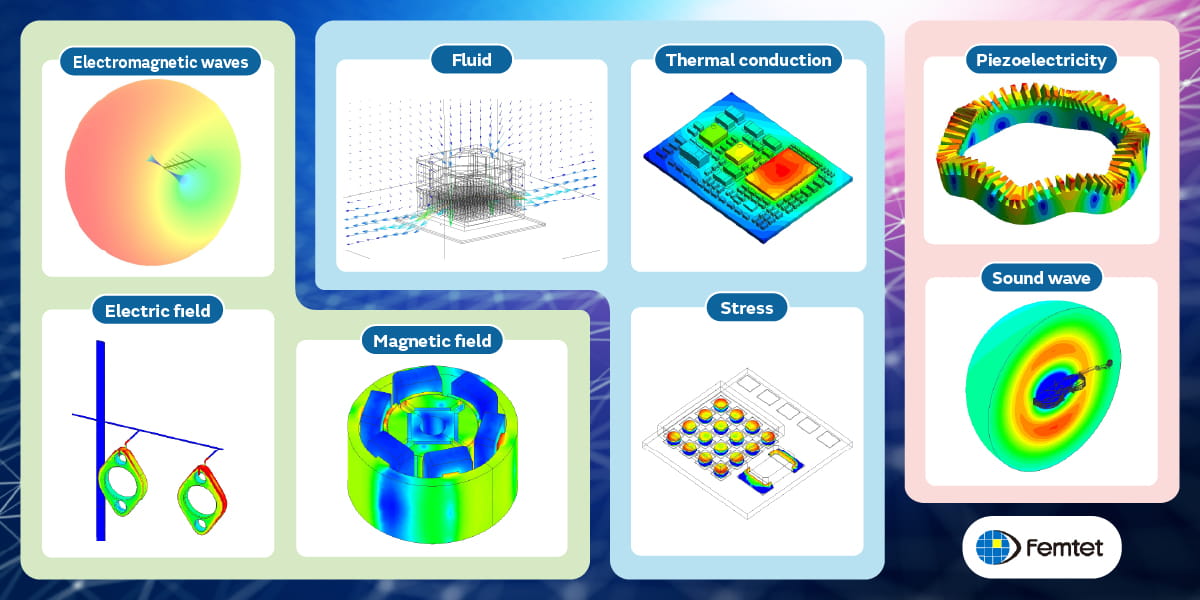
Simulation Examples
Simulation Examples

Technological Strengths

Murata's strength in simulation technology centers on its proprietary CAE (Computer-Aided Engineering) software, “Femtet.” Murata not only uses simulation tools but also possesses the technological capability to develop them in-house.

This deep, hands-on approach gives us a broad and comprehensive understanding of simulation technology, enabling rapid and highly accurate analysis across a wide range of processes, from the design stage to manufacturing sites. Field engineers and researchers are directly involved in improving “Femtet.” Their practical insights allow us to add targeted features and enhance performance to address specific challenges, which in turn accelerates the advancement of our analysis capabilities.

Based on its in-house developed CAE software, Murata has realized highly accurate simulation technology by leveraging extensive field knowledge and know-how across its engineering operations.

Femtet's Analysis Capabilities

Technological Advancement

Murata's simulation technology has progressed in tandem with the development of its proprietary CAE (Computer-Aided Engineering) software, “Femtet,” advancing through the integration of field expertise and state-of-the-art analysis techniques.

The origins of “Femtet” date back to 1982, when we developed an in-house program to analyze the relationship between vibration and frequency in a watch oscillator. Starting with the development of analysis for piezoelectric products and electromagnetic wave analysis for base station filters, the scope of analysis soon expanded to cover magnetic fields, heat transfer, stress, fluid dynamics, and acoustics. Continued pursuit of intuitive operability has greatly improved usability and efficiency for engineers. In recent years, we have incorporated advanced technologies such as AI to enable more sophisticated and comprehensive manufacturing simulations. These capabilities are contributing to the creation of new manufacturing technologies.

Evolution of Simulation Technology

Application examples for this technology

This technology is applied to Murata's products and their production processes, from research and development through mass production.

Link: The Forty-year Journey of Femtet, the CAE Software that Continues to Support Murata Manufacturing's Product Development with FEM Analysis (Case Study: echorb) Open the New Window

Examples of Simulation Technology Application ~Product Introduction~

Technology