26/11/2024
Murata Manufacturing Co., Ltd.
President: Norio Nakajima
Murata Manufacturing Co., Ltd. (Head Office: Nagaokakyo-shi, Kyoto / President: Norio Nakajima; hereinafter “Murata Manufacturing”) and TODA CORPORATION (Head Office: Chuo-ku, Tokyo / President: Seisuke Otani; hereinafter “TODA”) hereby announce that we have obtained ZEB
*1 certification. We have obtained this certification for the first attempt in Japan to use the solar panels to be installed in the Ceramic Capacitor R&D Center currently under construction for Fukui Murata Manufacturing Co., Ltd. (location: Echizen-shi, Fukui / President: Shinji Nomura; hereinafter “Fukui Murata Manufacturing”), a production subsidiary of Murata Manufacturing, in the temporary on-site office. Once the Ceramic Capacitor R&D Center is completed, we will relocate the solar panels for use at the new facility. Murata Manufacturing has begun efforts to reduce Scope 3 greenhouse gases at the time of construction. Meanwhile, TODA has started working toward engaging in environmentally friendly construction using ZEB design technology.
*1: When a building obtains Net Zero Energy Building (ZEB) certification, it means it is a building aiming to reduce to zero the annual primary energy balance consumed by the building. This zero balance is achieved through energy saving by improving thermal insulation and raising the efficiency of equipment and through energy creation by solar panels while realizing a comfortable indoor environment. This certification is divided into four ranks according to the energy reduction rate. It is necessary to achieve a reduction rate of at least 100% to obtain the highest rank of “ZEB.”

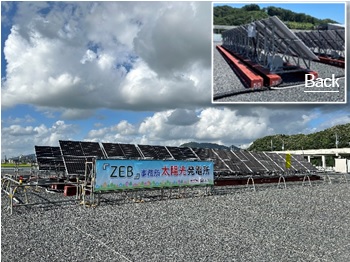
Photo 1: “ZEB” temporary office Photo 2: Solar panels for the temporary office
The international community must urgently accelerate its efforts to fight climate change. Against this backdrop, it is essential to take measures against Scope 3 emissions of other companies related to the activities of business operators to further accelerate the pace of efforts to reduce greenhouse gases in the future. Scope 3 accounts for 78% of Murata Manufacturing’s greenhouse gas emissions. Category 2 in Scope 3, emissions associated with the construction and manufacturing of our own capital goods, accounts for 12.6% of those emissions. This means it is important to reduce greenhouse gas emissions in collaboration with construction partners in the construction of our own facilities.

Fig. 1: Murata Manufacturing’s greenhouse gas emissions in FY2023
Murata Manufacturing and TODA planned a “ZEB” temporary on-site office (hereinafter the “Project”) when constructing Murata Manufacturing’s new research and development base called “Ceramic Capacitor R&D Center” in front of Echizen-Takefu Station in Fukui Prefecture.
The project includes the installation of solar panels at the Ceramic Capacitor R&D Center, which is currently under construction at the temporary on-site office. The power generated from these solar panels will cover 49% of the power used at the temporary on-site office during the construction period. In addition, we have taken measures that have allowed us to reduce the power used by the temporary on-site office by 54%. These measures include improving the skin heat performance of the temporary on-site office by adding heat-insulating materials to its roof, walls, and 1F floor and by affixing heat-shielding film to the windows. We also plan to incorporate highly efficient air conditioners with optimized capacity in anticipation of the operation of the office and set up LED lighting. We will verify the effectiveness of the ZEB in the project by setting up Murata Manufacturing’s IoT sensors in various places to monitor the temperature and the amount of power used by the air conditioners on a 24-hour basis. In addition, applying this technology will allow us to heat map the thermal environment in the temporary on-site office and then finely adjust the air-conditioning. That will enable us to promote energy saving while maintaining comfort.
We expect to be able to reduce CO2 by about 22.9 tons a year on a power conversion basis*2 for a net reduction in CO2 of 103% when we add up the power generated by these solar panels and those energy savings. Moreover, we will continue to use the solar panels once we have finished using this temporary office in the Ceramic Capacitor R&D Center without discarding them. This will thus also lead to the effective use of limited resources.
Furthermore, we are aiming to achieve even lower carbonization by using renewable energy power for construction until the full-scale reception of electricity is in the building. We anticipate that we will be able to reduce the CO2 associated with the power used during construction with this strategy.
We plan to install various energy saving and renewable energy technologies in the Ceramic Capacitor R&D Center. These technologies include adopting exterior walls and sashes with high thermal insulation performance, air-conditioning and lighting control linked to equipment and human activity, and solar power generation equipment. We are aiming to achieve ZEB Oriented*3 certification even after the building’s opening. Additionally, we intend to develop green spaces within the Ceramic Capacitor R&D center which will be made available to local residents. The center is also intended to accommodate people in the event of a disaster. We strive to achieve this, in line with our value to contribute to the local community.
*2: Converted using a CO2 emission factor of 0.499 kg-CO2/kWh (actual adjusted figures for FY2022 from Hokuriku Electric Power)
*3: ZEB Oriented: This refers to achieving 40% energy savings compared to the nationally stipulated standards in large offices, schools, factories, and other facilities with a total floor area of 10,000 m2 or more.

Fig. 2: Comparison of CO2 emissions with and without ZEB specifications
Murata Manufacturing has set “reinforcement of climate change countermeasures” as a priority issue. In September 2024, we set a new target to achieve carbon neutrality throughout our supply chain by 2050.
Murata Manufacturing will continue to accelerate the pace of our efforts to combat climate change in the future with the aim of realizing a sustainable society.
Murata in Brief
Murata Manufacturing Co., Ltd. is a worldwide leader in the design, manufacture and sale of ceramic-based passive electronic components & solutions, communication modules and power supply modules. Murata is committed to the development of advanced electronic materials and leading edge, multi-functional, high-density modules. The company has employees and manufacturing facilities throughout the world.
For more information, visit Murata's website