Governance

In order to sustainably improve Murata's business value and continue being a company trusted by society, we are engaged in establishing and maintaining appropriate governance system. Please refer to the following link for information on the corporate governance system, and the following contents for details on each initiative.

Link: Corporate data: A closer look at corporate governance

Reinforcing risk management

Basic approach

In order to sustainably improve the enterprise value of the entire Group, Murata is building a risk management system to appropriately manage the various internal and external risks related to its business activities. Moreover, twice a year, we are engaging in activities to reduce loss when risks which have a significant impact on our business activities are discovered such as regularly classifying and evaluating each risk concerning our overall business activities and implementing countermeasures in advance according to the priority, etc.

Promotion structure

Murata established the Risk Management Committee, chaired by our president and co-chaired by our risk management officer, to consider measures for countering company-wide risks. The Information Security Subcommittee and BCM* Subcommittee have also been established as subordinate bodies for forming and implementing countermeasures for individual risks.

  • BCM (Business Continuity Management) : Management activities are operated on an ongoing basis to formulate, maintain, and renew the BCP (Business Continuity Plan), to allocate budget and resources for business continuity, to take preventative measures, and to conduct, check, and continually improve education and training for permeating initiatives.
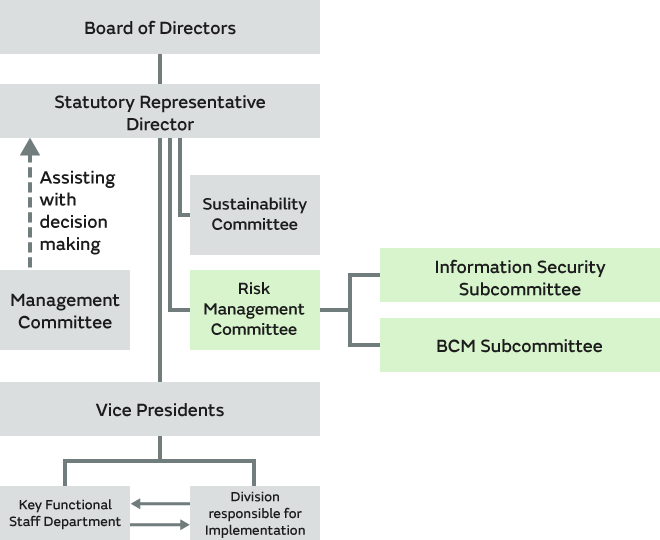
Risk management promotion system diagram

Link: Murata’s Corporate Governance System

Understanding risks

Twice a year, the Key Functional Staff Department and the Business Division responsible for implementation, which are responsible for risks, routinely extract the risks that the Murata Group is currently facing or risks that are expected in the near future. The Key Functional Staff Department is preventing oversights in risk identification and working to build a system that can appropriately respond to risks by correctly recognizing (1) risks which must be identified as company-wide risks from among those extracted by the Business Division responsible for implementation and (2) risks that the Key Functional Staff Department and Business Division responsible for implementation must share and cooperate for. (Refer to the figure below) Moreover, the extracted risks are comprehensively identified and managed by evaluating the importance based on the frequency of occurrence and impact and then displaying the risks on a risk map.

The risk management committee reviews the details of risks with a high degree of importance and urgency from among the risks which are extracted in this manner and issues instructions for added countermeasures as needed. In addition, the departments which are responsible for each risk report on those risks with a high degree of importance and urgency to management within the board of directors and management committee. This enables management to identify the corresponding risks and take the appropriate risk countermeasures.

The Internal Audit Department also monitors for the proper implementation of the PDCA cycle for risk management in the company through direct and indirect audits of the Risk Management Committee and Key Functional Staff Department.

Company-wide risk management system

Business and other risks

Risks that may have a material impact on the company include the following. The frequency of occurrence and the degree of impact of residual risk remaining after implementing each risk countermeasure, are classified into the three categories – “High,” “Medium,” and “Low.” With regard to the degree of impact, an indicator is selected from the five indicators of “Organizational impact,” “Impact on production activities, etc.,” “Regulatory/administrative impact,” “Impact on business transactions,” and “Media/reputational impact” and classification is made based on the criteria that has been set in advance for each indicator. For more details about each risk, refer to the Annual Securities Report (date of submission: June 24, 2025).

External environmental risks

Risk categories Risk description Primary response Frequency of occurrence Impact
Risks relating to global business development
  • Political situation in the corresponding country and region that we are entering, taxation and other legal systems, various regulations pertaining to finance and import/export, the status of social capital development, other special regional characteristics, and the impact of sudden changes in these factors
  • Thorough discussion of risks before starting operations overseas
  • Promote the multipolarization of production sites
  • Build an alternative production system
  • Build a system for gathering information about the international situation on multiple fronts
Medium High
Risks relating to exchange rate fluctuations
  • Impact of exchange rate fluctuations on production, sales, and other business activities as well as the company's performance and financial condition
  • Configure the appropriate sales prices which anticipate exchange rate fluctuations
  • Implement exchange contracts for a certain percentage of foreign currency denominated transaction amounts
High High
Risks related to financing
  • Lack of internal funds for investment aimed at business growth and capital requirements for working capital
  • Fundraising through borrowing from banks and the issuing of domestic straight bonds
Medium Medium
Risks related to environmental regulation
  • Costs increase in order to adapt to domestic and overseas environmental regulations
  • Ongoing initiatives to reduce waste
  • Form an environmental committee chaired by the executive officer in charge and promote the undertaking of environmental measures

Link: Create a recycling-oriented society

Link: Manage chemical substances

Link: Prevent pollution

Medium Medium
Climate change related risks
  • Increase in plant building and operating costs following introduction of carbon pricing as well as the advancement of stricter energy conservation standards (transition risk)
  • Complete shutdown of major plants and raw material supply disruptions due to typhoons, heavy rainfall, and other abnormal weather (physical risks)
  • Actively introduce energy conservation and initiatives to reduce CO2 in collaboration with suppliers
  • Utilization of internal carbon pricing system
  • Strengthen each initiative in accordance with TCFD and SBT guidelines

Link: Create a decarbonized society

Link: TCFD measures

Medium High
Risks related to resource depletion <See the section on emerging risks> Low Medium
Risks related to the suspension of business activities due to disasters and infectious disease, etc.
  • Long-term suspension of business activities due to the occurrence of High-scale natural disasters and the spread of infectious disease, etc. at business locations
  • Place production sites in a distributed manner in domestic and overseas locations
  • Implement disaster drills and business continuity drills on a regular basis

Link: Business Continuity Management (BCM)

Link: Secure and safe workplace and health management

Low High

Strategic risks

Risk categories Risk description Primary response Frequency of occurrence Impact
Risks related to fluctuations in the demand for our products
  • The occurrence of surplus assets, etc. or the loss of sales opportunities due to sudden changes in the global economic situation
  • Diversify risks through business development in the environment and wellness market while maintaining edge devices, IT infrastructure, and mobility as the core fields
  • Arrange for the appropriate production facilities and necessary staff based on medium to long-term demand forecasts
  • Continuously improve production efficiency through the promotion of DX
  • Flexibly adjust production capacity and the number of working days
Medium High
Risks related to product competitiveness (market share)
  • Decrease in the company's market share after a loss of competitiveness
  • Continuously release new, high value-added products
  • Continuously and proactively promote cost reduction
  • Develop a supply capability that is able to meet customer demand in a timely manner
  • Maintain and expand our share through sales networks and other overall strengths
Medium Medium
Risks related to dependencies on specific partners and products
  • Sales decline in the event that product sales of a specific partner stagnate
  • Sales decline in the event that the demand for a specific product decreases
  • Partner diversification
  • Earnings diversification through new businesses and other forms of expansion
Medium Medium
Risks related to M&A, business alliances, and strategic investment
  • Difficulty in implementing appropriate M&A, partnerships, and strategic investments due to drastic changes in the market and competitive environments
  • Notable changes in the market environment and conflicting interests between business partners or incurring additional costs due to the loss of human resources and the impact of the impairment loss of goodwill and long-term assets
  • Conduct a comprehensive risk analysis of the target market and assess the financial health of the partner company. Implement regular evaluations of these factors, adjust strategies as needed, and execute organizational restructuring where necessary.
Medium High

Management foundation risks

Risk categories Risk description Primary response Frequency of occurrence Impact
Risks related to information security
  • Information leaks and the suspension of corporate activities due to internal fraud and cyber attacks
  • Impact of the exposure of private information and the violation of legal and regulatory matters
  • Implement measures in terms of the three human, technical, and physical aspects based on information security management

Link: Information Security

High High
Risks related to public regulations and compliance
  • Disposition by a supervisory authority due to violations of the antimonopoly act, export and import regulations, and other public regulations, filing of a lawsuit, suspension of business activities, and other risks, damage to the corporate brand value, and loss of social trust
  • Install a compliance promotion committee, enact a "corporate ethics policy and code of conduct," and carry out compliance promotion activities

Link: Compliance

Low High
Risks related to intellectual property
  • Business execution and in-house development limitations based on the intellectual property rights of other companies
  • Survey and confirm the intellectual property rights of other companies at the appropriate time during design development
  • Enhancement of deterrence against other companies through acquisition and accumulation of appropriate intellectual properties based on inventions

Link: Measures concerning intellectual property

Medium Medium
Risks related to taxation
  • Payment of back taxes and the resulting damage to our credit worthiness
  • Dual taxation due to taxation under transfer pricing regulations
  • Implement tax processing in accordance with "global tax policies"
  • Establish a specialized tax organization
  • Secure and train human resources with specialized knowledge and extensive experience
Medium Medium
Risks related to the hiring and securing of human resources
  • Intensified competition to acquire human resources who possess superior expertise
  • Strengthen our activities to hire human resources for new markets and outstanding human resources for DX
  • Implement various measures to increase employee motivation such as expanding the education system to support capability development and personnel placement emphasizing capability and aptitude

Link: Developing leaders who can change the future

Link: Dynamic resource allocation

Medium Medium
Risks related to human rights
  • Legal risks such as litigations and administrative sanctions arising from violation of human rights, talent drain and labor disputes, damage to corporate brand, and loss of social credibility
  • Establish a human rights due diligence system and continuously operate that system
  • Establish multiple internal and external consultation desks, including outside experts
Medium Medium

Business execution risks

Risk categories Risk description Primary response Frequency of occurrence Impact
Risks related to the development of new technologies and products
  • Contraction of existing markets due to technology innovation
  • Impact of the shortening of the lifecycle of existing products
  • Continuous and proactive implementation of the research and development investment required for new technologies and new product development

Link: Murata value report: Message from the Director of Corporate Technology & Business Development Unit

Link: Measures concerning intellectual property

Low High
Risks related to procurement
  • Suspension of the supply of material products and price increases due to problems in the business management of a supplier, deterioration of public order, spread of infectious disease, disasters (man-made and natural), depletion of resources, etc.
  • Secure adequate stock based on a material product inventory policy, develop multiple supply chains, and confirm Business Continuity Planning (BCP) by suppliers in advance
  • Create a database of the production locations of material suppliers and develop a rapid recovery and response system by formulating an initial response flow

Link: Responsibility to and actions concerning suppliers

Medium Medium
Risks related to quality
  • The occurrence of compensation liability and loss of trust due to accidents caused by product quality, market recalls, and production suspension, etc.
  • Develop a quality assurance system to observe product compliance
  • Audit and provide guidance to clients and other collaborators
  • Build in quality during every stage from development to shipping

Link: Responsibility to customers for quality and action

Medium High

Emerging risks

Below are emerging risks that are new or those that may significantly impact the business of Murata in the future, along with what we are doing to handle these risks.

Risk description Risk explanation Impact on Murata Impact mitigation measures
Resource depletion The growing global population and economic expansion are intensifying the supply-demand tension for mineral resources and raising the risk of long-term depletion, which may make stable procurement of raw materials more difficult in the future. Raw material supply shortages and drastic increases in resource prices could result in higher manufacturing costs. If we are unable to proceed according to our plan in switching to alternative or recycled materials, it could result in a loss of social trust, have a serious impact on our business performance, or pose financial threats.
  • Reduce the amount of raw materials used by thoroughly downsizing products, increasing efficiency, and increasing product lifespan
  • Use alternative resources and recycled materials, and enhance efforts to recycle company waste into resources
  • Increase recycling efficiency throughout the value chain by building resource recycling network in collaboration with suppliers and other related entities
Geopolitical risks Stricter import/export regulations and sudden changes in exchange control and tariff policies resulting from increasingly intense competitions between major countries could cause supply chain issues such as sudden costs increases, interruptions, and segmentation. Production stoppages or delays at domestic or overseas sites—caused by raw material shortages, facility issues, higher tariffs, import/export regulations, or a global drop in demand—could seriously impact our business performance and financial condition.
  • Promote building production systems in multiple countries and multiple sites, and ensure that multiple vendors are used to procure important materials
  • Ensure sufficient inventory for emergencies, and enhance the effectiveness of business continuity planning (BCP)
  • Assign dedicated teams to monitor the laws, regulations, and political trends in each region
Rapid advances in AI technology If we are unable to keep up with advances in AI technology, it may become impossible to increase productivity or provide value to customers, and compliance risks could increase, which could reduce our competitiveness. If Murata falls behind the competition in taking advantage of AI and our competitiveness decreases, or if inappropriate use of AI violates related laws or ethics or results in the leaking of confidential or personal information, it could result in a loss of social trust or have a serious impact on our business performance or financial conditions.
  • Establish a dedicated working group to strategically promote use of generative AI
  • Establish rules and employee training programs on using AI
  • Conduct periodic security assessments and ensure strict access control and encryption

Business Continuity Management (BCM)

Murata set Business Continuity Management (BCM) as a key issue in fiscal 2019, and since then has continued to promote various measures and implement continuous improvements.

Background for setting material issue

Companies are expected to prioritize human life and safety while quickly resuming product supply and to fulfill social obligations, even if an emergency arises with a significant impact on business. To become the top components manufacturer in the world, Murata has set this as a material issue with the understanding that promoting global business continuity management is a key issue.

Our goal

We aim to build BCM organizations in domestic and overseas business sites and plants, in order to prepare for disaster.

Basic BCM policy

  • 1.

    Ensure the safety of employees and others, and then work toward preventing secondary disasters.

  • 2.

    Do everything possible to resume production and keep supplying products to markets.

  • 3.

    Support regional recovery as member of the local community.

  • 4.

    Thoroughly implement required advance measures after taking costs and benefits into consideration, in order to minimize asset loss during a disaster and to resume production more quickly.

  • 5.

    Revise the Business Continuity Plan (BCP) regularly and as the business environment changes, in order to continuously improve business continuity organizations.

  • 6.

    Establish business continuity organizations with all employees working together under the proactive leadership of management.

Specific initiatives

Business Continuity Plan (BCP)

A major natural disaster has the potential to bring business to a stop for extended periods. Consequently, Murata has devised a Business Continuity Plan (BCP) to ensure that we can fulfill our duty to provide customers with a stable supply of products. We are conducting initiatives to minimize damage and continue business, such as ensuring earthquake resistance and safety for buildings and production facilities, constructing backup frameworks for our communications and information systems, and maintaining supply from inventory.

Within material procurement, the production locations of material suppliers are stored in a database so that procurement activities are not delayed when a disaster or other risk occurs. We are also formulating an initial response system and an initial response flow for expected risks aimed at the implementation of a rapid initial response. Furthermore, with regard to important materials we are promoting measures such as implementing a multi-vendor system, confirming the BCP implementation status of our vendors, and ensuring sufficient inventory to cover the expected recovery period, if risks materialize, as measures to ensure stable procurement.

In addition, we are working to confirm effectiveness and continually improve initial response measures, improve crisis response capabilities, and find points to be improved regarding BCP by conducting periodic disaster drills and business continuity drills. During fiscal 2024, we developed and strengthened BCPs that cover the required items (possible scope of damage, action plans required for business continuity, and advance measures) at both our domestic and overseas business sites and plants and worked on establishing a BCP to prevent risks that would impair business continuity and to minimize loss if risks should materialize. Although some of our manufacturing sites were severely affected due to the Noto earthquake in January 2024, production was handled by putting BCP into action including production at other sites.

Future initiatives

We must promote the establishment of BCM organizations to handle risks that could occur at the global level, prevent risks that could impair Murata's business continuity, and minimize loss if risks should materialize.

Toward that end, Murata conducts regular drills and other activities at domestic and overseas business locations in order to verify the effectiveness of our BCP to revise it when required. We also continue to put autonomous BCM activities into practice. Additionally, we continue to work toward reinforcing business continuity organizations through measures such as further diversifying production sites in order for the entire group to continuously supply products to the markets.

An earthquake in the Nankai Trough would be especially massive and damaging, and we realize that we must prepare for this. We continue to promote measures in order to fulfill our obligations as a components manufacturer to continue to supply products.