Common Technology
Measurement Technology
(EMC Evaluation Technology)
Measurement Technology (EMC Evaluation Technology) icon

Measurement Technology (EMC Evaluation Technology) icon

Summary

  • Generally, EMC (Electromagnetic Compatibility) evaluation technology assesses the impact of noise emitted by electronic devices on surrounding equipment, as well as the risk of device malfunction caused by external electromagnetic waves. Compliance with EMC standards established by each country is an essential requirement for bringing products to market.
  • Murata's EMC evaluation technology goes beyond mere compliance testing. We perform optimal evaluations and analyses tailored to each product's characteristics and usage environment. By resolving noise issues, we contribute not only to product reliability but also to enhancing customer satisfaction and market competitiveness.
  • The strength of Murata's EMC evaluation technology lies in possessing both the foundational technology supporting advanced testing environments compliant with international EMC standards, and the applied technology to execute appropriate evaluations utilizing those environments. By maintaining high-level EMC evaluation technology in-house and continuously improving it, we enhance trust from customers and partners. This enables us to achieve sustainable growth in the intensely competitive electronic components industry.
  • Murata's EMC evaluation technology has advanced by enhancing equipment and refining evaluation methods in response to market changes and evolving needs. It flexibly adapts to constantly changing market environments, contributing to the creation of highly safe products and the improvement of society's electromagnetic environment.

Murata's Measurement Technology (EMC Evaluation Technology)

Technical Explanation

Murata's EMC evaluation technology goes beyond mere compliance testing by performing flexible, multifaceted assessments tailored to product needs. This approach makes it a crucial foundational capability for enhancing product reliability, increasing customer satisfaction, and strengthening market competitiveness.

It integrates a wide range of specialized techniques, including measuring noise generated by electronic devices to grasp its impact;
analyzing noise waveforms and frequency components with high‑bandwidth oscilloscopes and spectrum analyzers;
identifying sources and propagation paths through near‑field electromagnetic measurements and conducted noise measurements;
and determining root causes using noise‑mode separation and simulation.

By applying these methods in accordance with product structure and application, Murata can mitigate risks that standard compliance testing often fails to detect. This enables concrete countermeasures, such as revising board layouts and optimizing component selection. Evaluation engineers work in close collaboration with development teams from the earliest design stages, providing EMC‑focused recommendations that support the creation of highly reliable products.

EMC Evaluation Technology

Technological Strengths

Murata’s strength in EMC evaluation technology lies in its ability to combine foundational technologies that support testing environments compliant with international EMC standards, with applied technologies that leverage these environments to plan and carry out precise evaluations.

On the foundational side, our operations fully comply with ISO/IEC 17025 — the international standard for the competence of testing and calibration laboratories. At our Yokohama facility, we operate an anechoic chamber and shielded rooms, both certified by an independent third‑party organization, ensuring world‑class EMC testing capabilities.

On the applied side, Murata draws upon its expertise in noise suppression components with a global presence to select evaluation items and methods tailored to each product’s structure and stage of development. We respond flexibly to customer specifications and unique requirements, and we carry out diverse initiatives such as identifying noise sources and propagation paths through specialized evaluations.

By possessing such a high‑level testing environment, we can evaluate a wide variety of products quickly and accurately. The insights gained from these evaluations are directly fed back into improving our testing facilities, helping us to define and expand the range of applications our EMC capabilities can address.

By building and continually refining these advanced EMC evaluation technologies, Murata has earned the trust of customers and partners, and strengthened its position in the market. This capability is a key factor that enables sustainable growth in the highly competitive electronic components industry.

Radiated Emissions (10m Method)
Radiated Emissions and Immunity (3m Method)
Radiated Emissions for Vehicle Components

EMC Anechoic Chambers and Test Items

Conducted Emissions
Conducted Emissions
Electrostatic Discharge

Shielded Rooms and Test Items

Technological Advancement

Murata’s EMC evaluation technology continues to advance by enhancing testing environments and refining evaluation methods in response to market changes.

In the communications market, our evaluation capabilities have evolved alongside generational shifts in mobile communication systems. Mobile devices face the challenge of desensitization issue caused by internal noise. Since the introduction of 4th Generation (4G) mobile communications, the widespread adoption of MIMO (Multiple Input Multiple Output) has made traditional cable connected evaluations difficult. To address this, we have introduced OTA (Over The Air) environments that simulate actual propagation conditions. For 5th Generation (5G) systems, we have also implemented evaluation equipment compatible with millimeter wave frequency use.

In the medical device market, we have improved measurement accuracy for small signals and high frequency bands to meet the growing demand from high precision electronic devices. We also conduct evaluations that simulate real medical environments, establishing a system capable of more accurately verifying product safety and reliability.

In the automotive market, the increasing electrification of vehicles and advances in autonomous driving technologies have led to a rise in both the number and complexity of electronic devices. Initially, we established anechoic chambers and shielded rooms dedicated to in vehicle components testing. However, evaluating devices in isolation has limitations in identifying noise issues early when installed in a vehicle. To overcome this, we introduced a full vehicle anechoic chamber capable of EMC evaluations during driving and charging. This enables comprehensive assessments that reproduce the operation of the entire vehicle, not just individual components.

Looking ahead, EMC verification is expected to integrate more extensively with advanced virtual environments, such as large scale electromagnetic field simulations and HILS (Hardware In the Loop Simulation). Murata will continue to leverage these technologies while providing precise evaluation results using actual equipment. Through this approach, we aim to contribute to the creation of highly safe products and to the improvement of the overall electromagnetic environment in society.
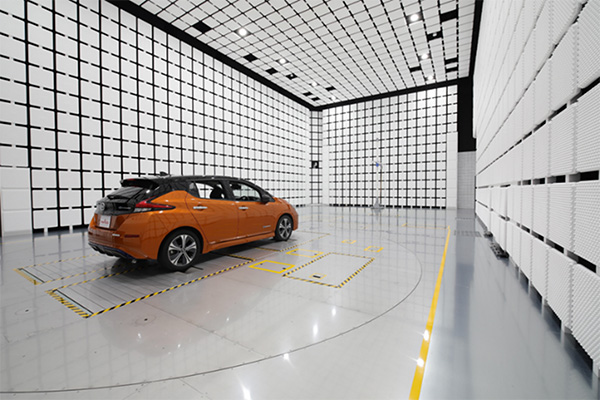
Vehicle-Specific EMC Anechoic Chamber

See here for related Murata technologies.

Examples of Measurement Technology Application ~Product Introduction~

Technology