Murata's power module design technology has incorporated evolving components and new material technologies. This has led to dramatic improvements in power conversion efficiency and power density.
Bipolar transistors, first used in the 1950s, represent the origin. Subsequently, semiconductor devices such as IGBTs (Insulated Gate Bipolar Transistors) and MOSFETs (Metal Oxide Semiconductor Field Effect Transistors) came into use. This enabled higher efficiency and higher-performance power conversion.
From the 1980s to the 1990s, circuit designs transitioned from hard switching to soft switching. The adoption of resonant circuits reduced switching losses. This significantly improved power conversion efficiency. Simultaneously, it suppressed overall heat generation within the power module.
To address the harmonic current suppression regulations established during this period, Murata introduced EMI countermeasure and noise reduction technologies, enabling us to provide products that complied with regulations while maintaining high quality.
In the 2000s, digital control technology became widely adopted. This resulted in a dramatic improvement of accuracy in the control of power modules. More complex control became possible. Flexible product design tailored to demand was realized. Consequently, rapid response to new market needs, such as servers and IoT devices, became achievable.
In recent years, advancements in compound semiconductors and new circuit design are anticipated. This is driving further improvements in efficiency. Simultaneously, the application of water-cooling and liquid-immersion cooling technologies has become increasingly necessary. Murata continues to refine its conventional technologies. At the same time, it actively incorporates these new technologies. As a result, it continues to respond flexibly to market and customer needs.
Thus, Murata's power modules have evolved over a long history. Today, they have grown into products combining high power conversion efficiency and reliability. And even now, Murata continues to pursue the next technological innovation.
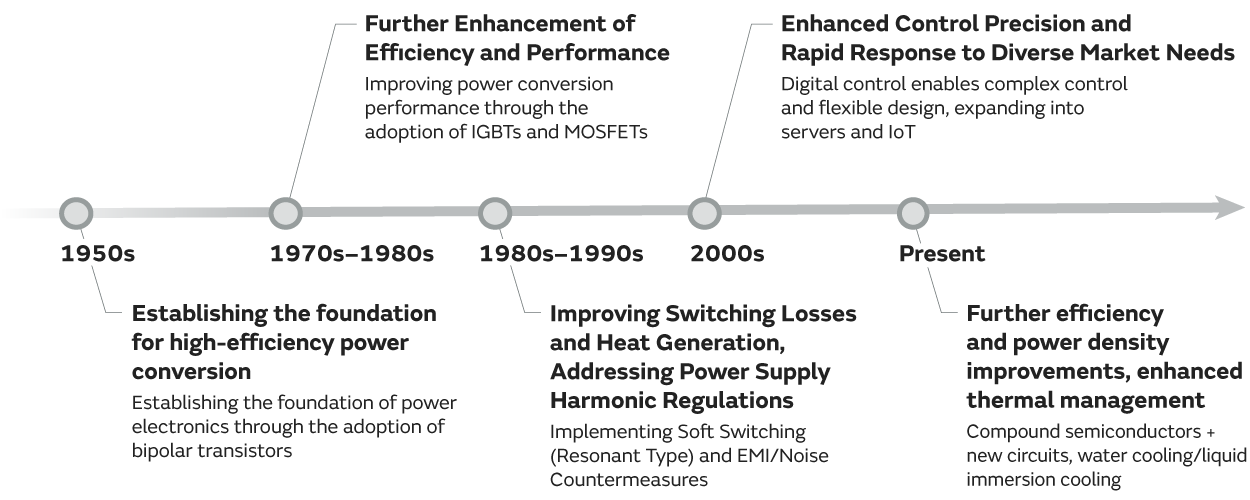 Evolution of Murata's Power Module Design Technology