Product Design Technology Power Module Design Technology

Power Module Design Technology icon

Summary

  • Generally, power module design technology refers to the overall technology for designing power modules that convert electrical power (voltage/current) into different forms of electrical power.
  • Murata's power module design technology is based on circuit and component design technology that selects appropriate circuits and components according to specifications. Furthermore, it utilizes thermal design technology to properly control heat generated by components. Additionally, it incorporates magnetic design technology to achieve optimal magnetic components. It also possesses structural design technology and safety design technology that consider productivity and user safety while keeping each characteristic. Moreover, it combines software design technology to implement control and Communications functions.These technologies enable us to meet custom requirements.
  • The strength of Murata's power module design technology lies in the knowledge of components cultivated as a comprehensive electronic component manufacturer. We also have many years of experience providing power modules for various applications. Furthermore, we have collaboration between our design hubs around the world.
  • Through the evolution of these technologies and the introduction of water cooling and immersion cooling technologies, we will respond to the demands for higher efficiency and higher power density, which will accelerate in the future.

Murata's Power Module Design Technology

Technical Explanation

Murata's power module design technology is a comprehensive technology that contributes to energy conservation and GX (Green Transformation). This technology enables the realization of high-efficiency, high-power-density power modules. Multiple elemental technologies are combined to exert maximum performance.

  • Circuit and Component Design Technology: Circuit and component design technology selects the appropriate circuit configuration according to conditions such as voltage, power, and size. It aims for high efficiency through combinations with compound semiconductors and other technologies. This enables the realization of circuits that meet the required functions and characteristics.
  • Magnetic Design Technology: Magnetic design technology is the technology for designing transformers and inductors, which are the core components of power modules. It optimizes core materials and winding structures to realize low-loss magnetic components.
  • Thermal Design Technology: Thermal design technology selects structures and materials that optimize thermal conduction, radiation, and convection. This effectively controls heat generated by components.
  • Structural Design Technology: Structural design technology ensures component heat dissipation and noise resistance. Simultaneously, it achieves optimal layouts considering productivity.
  • Safety Design Technology: Safety design technology protects users from hazards such as electric shock and burns. Designs compliant with international safety standards ensure high safety levels.
  • Software Design Technology: Software design technology implements digital control and Communications functions. It provides advanced control of multiple switching elements. It delivers secure Communications functions. Furthermore, it offers user-friendly interfaces.

By comprehensively combining these technologies, we provide high-efficiency, high-power-density power modules tailored to specific markets and applications. As a result, we contribute to energy savings and reducing environmental burden.

Comprehensive technology enabling high efficiency and high power density in power modules

Technological Strengths

Murata's strength in power module design technology lies in the extensive knowledge and experience cultivated as a comprehensive electronic component manufacturer. This strength enables us to maximize the characteristics and reliability of each component. Murata possesses deep expertise in diverse electronic components. Furthermore, through close collaboration with other component manufacturers, we rapidly incorporate the latest components. This enhances product performance.

Specifically, we combine our own ceramic capacitors and ferrite beads with MOSFETs (Metal Oxide Semiconductor Field Effect Transistors) and other components from other manufacturers. This optimizes the performance of the entire system. As a result, we achieve noise reduction and improved power conversion efficiency. We also conduct our own temperature characteristic verification and life testing. We thoroughly evaluate the characteristics of adopted components and provide feedback. This enables optimal component selection during the design phase, enhancing reliability.

In this way, through the knowledge of electronic components cultivated over many years, collaboration with other companies, and our systems for evaluation and feedback, we continually strive to improve performance and reliability.

Murata maintains power module design and development hubs worldwide. Each hub possesses its own unique strengths and expertise. Information and technology are shared between hubs. Development is sometimes advanced collaboratively. This approach fosters the creation of new technologies and applications. These strengths underpin Murata's design of high-efficiency, high-power-density power modules.

A system that continuously strives to improve performance and reliability
Collaboration among design and development hubs worldwide with unique expertise

Technological Advancement

Murata's power module design technology has incorporated evolving components and new material technologies. This has led to dramatic improvements in power conversion efficiency and power density.
Bipolar transistors, first used in the 1950s, represent the origin. Subsequently, semiconductor devices such as IGBTs (Insulated Gate Bipolar Transistors) and MOSFETs (Metal Oxide Semiconductor Field Effect Transistors) came into use. This enabled higher efficiency and higher-performance power conversion.

From the 1980s to the 1990s, circuit designs transitioned from hard switching to soft switching. The adoption of resonant circuits reduced switching losses. This significantly improved power conversion efficiency. Simultaneously, it suppressed overall heat generation within the power module.
Murata introduced EMI (electromagnetic interference) countermeasure technologies and noise reduction technologies to comply with the harmonic current suppression regulations established during this period. This achieved both regulatory compliance and high quality.

In the 2000s, digital control technology became widely adopted. This resulted in a dramatic improvement of accuracy in the control of power modules. More complex control became possible. Flexible product design tailored to demand was realized. Consequently, rapid response to new market needs, such as servers and IoT devices, became achievable.

In recent years, advancements in compound semiconductors and new circuit designs are anticipated. This is driving further improvements in efficiency. Simultaneously, the application of water cooling and liquid immersion cooling technologies has become required. Murata continues to refine its conventional technologies. At the same time, it actively incorporates these new technologies. As a result, it continues to respond flexibly to market and customer needs.

Thus, Murata's power modules have evolved over a long history. Today, they have grown into products combining high power conversion efficiency and reliability. And even now, Murata continues to pursue the next technological innovation.
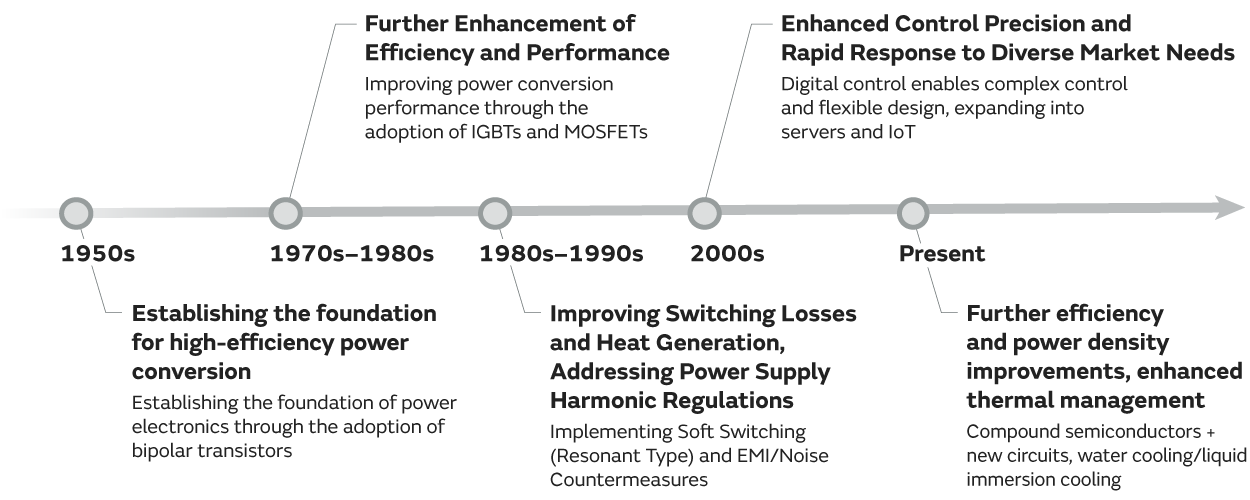
Evolution of Murata's Power Module Design Technology

Application examples for this technology

  • Server Power Modules
  • Storage Power Modules
  • Network Switch Power Modules
  • Industrial Equipment Power Modules
  • Communications Base Station Power Modules
  • Home Appliance Power Modules

*Link to the product information site.

Link: Power ProductsOpen in New Window

Examples of Power Module Design Technology Application ~Product Introduction~

Technology