Human resource allocation and development
Approach of human resource allocation and development
Recognizing that long-term career development is fundamental to our sustained growth, Murata's human resource management focuses on fostering enduring careers. We believe that providing employees with rich experience and opportunities for education and training will promote employees growth. Therefore, we carefully align company needs with individual career plans when allocating and developing talent.
We have also formulated the basic policy for human resources development that serves as a basic approach for supporting employees’ growth and career planning. We aim to provide fair opportunities based on each employee's skills and expertise, and will realize a corporate culture of mutual nurturing and development by heightening three abilities – the ability of the individual to grow, the ability of superiors and the work environment to nurture, and the ability of the company to foster.
- Scope: Consolidated (domestic)
Human resource allocation and development initiatives
The initiatives include job rotations, educational opportunities tailored to each level/allocation, management capability development, and career path diversification.
Development of human resources through job rotation and allocation
- Onboarding interview for assigned posts, follow-up interview, and fifth-year Career Development Plan (CDP) interview
- External secondment
- Overseas Trainee Program:
For young employees up to the age of 35, we provide one year of on-the-job training at overseas locations. By building work experience abroad from an early stage in their careers, we help raise their readiness for future overseas assignments. In fiscal 2025, 164 employees took part.
- Recruitment system that includes reskilling for specific job types:
Since 2024, we have introduced an in-house recruitment system with reskilling programs as one of our human resource allocation initiatives. In the open recruitment process, we place the highest priority on applicants' willingness to take on challenges and match them with target roles. After matching, we set a six-month reskilling period, with the aim of broadening the scope in which employees can excel by combining their work experience within Murata with newly acquired knowledge and skills. Through this system, we promote cross-functional mobility and, by expanding the options available in individuals' careers, aim to achieve a virtuous cycle of individuals and the company.
- Venture Internship Program:
This is an open recruitment program in which employees work at a venture company for a set period, with the aim of developing people who can broaden their horizons beyond the company and create change. The diverse perspectives, skills, and mindsets they gain through hands-on work at the frontier of innovation and through cross-cultural experiences are brought back to the organization. The program began in 2020, and a total of 13 employees have taken part across five terms to date.
- Practical factory training program for new employees (including overseas manufacturing sites):
The factory training program, in which new employees experience hands-on work at manufacturing sites over approximately five months, has been conducted since fiscal 2009, and a cumulative total of 4,260 employees have completed it. Through shift work including night shifts, on-site work, and improvement proposals, participants learn ways of thinking about safety, quality, cost, and lead time, as well as teamwork. Building up these on-site experiences together with peers who joined in the same year fosters mutual understanding and relationships of trust, which become the foundation for coordination and a sense of unity in their work after the training. By collaborating with employees in the manufacturing division, they also come to understand the people and roles that support the front line, deepening their understanding of and respect for Murata's business. These connections with peers and this understanding of the front line encourage employees to act on their own initiative and to thrive at Murata over the long term. Since fiscal 2023, looking ahead to further globalization, we have also begun training at overseas manufacturing sites, creating opportunities for employees to experience firsthand, from their very first year, the appeal of working globally and the challenges they face in a different cultural environment.
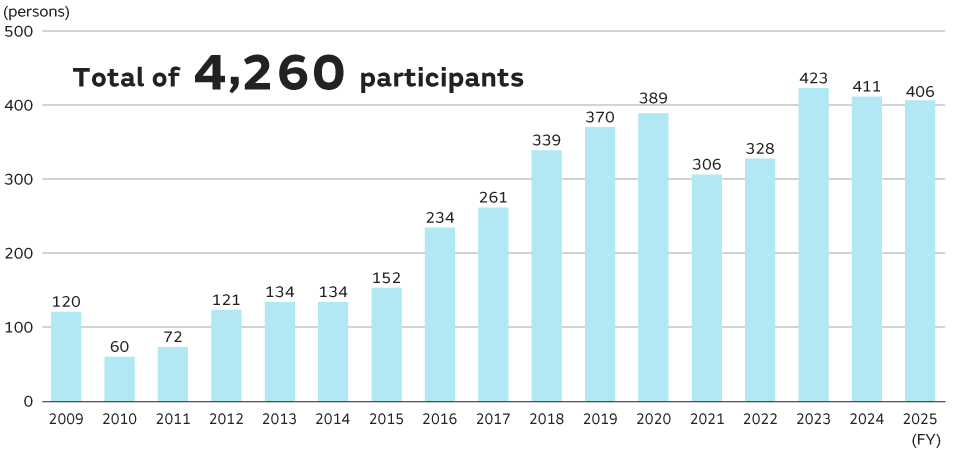 Number of participants in factory training program (per fiscal)
Strengthening management development
Centered mainly on managerial positions, we are also enhancing training to strengthen the overall management capabilities of the company. One of these is Murata Management Basics (MMB) training, a program spanning approximately eight months that involves group training and repeated practice in the actual workplace. Members who have been promoted to positions equivalent to junior manager in the Murata Group in Japan are required to participate. The program aims for them to learn the basics of management and to mutually enhance one another by discussing the various challenges they encounter while practicing management. Participants also learn the importance of developing a mindset that recognizes that the responsibility for fostering future management candidates is their own and of consciously assigning work to subordinates and supporting their self-reflection. Since launching the program in 2008, a cumulative total of 2,374 individuals have participated as of the end of fiscal 2025.
In addition, we are enriching our programs to improve the likelihood of growth as leaders, for example by conducting assessments such as 360-degree evaluations to deepen self-awareness and by introducing a mentoring system that incorporates feedback from inside and outside the company to drive self-transformation.
Development of next-generation management leaders
At Murata, in order to continuously produce management leaders who can drive the company's growth and development, we also focus on developing management executive candidates. We develop personnel selected from among all employees with a long-term perspective, systematically providing selective development programs tailored to each level, from mid-career employees through to managerial positions. A distinctive feature of every program is that officers are directly involved, coming together to support each candidate's growth. We have also defined the competencies required of management leaders and provide coherent, consistent development that leads to sustainable succession.
Various training programs and educational opportunities
Even after their assignment, we systematically provide specialized functional training, such as training by function and technical training, so that each employee can continue to hone their expertise and deliver business results. Furthermore, to respond to changes in the business environment, we treat the use of digital technology and AI as a foundational capability shared across the entire company and provide foundational DX education for all employees. In addition, to develop people who will drive transformation within each organization, we provide specialized education by job type and role for those who will play a leading role in promoting DX, working to develop practical DX talent who connect the front line with management.
We also actively support employees in obtaining public certifications so that they can chart their own careers and develop their expertise. Specifically, when employees voluntarily obtain certifications that enhance the knowledge and quality of their work, the company covers the full cost, including examination fees.
Link: To make DX a corporate culture through human resource training
Training of manufacturing personnel
Murata’s source of value creation is manufacturing―which makes the cultivation of manufacturing personnel a key challenge. We practice scientific management at the forefront of manufacturing and continuously work to enhance development schemes for worksite improvement facilitators, who bring out improvement effects on sites, and maintenance engineer, who are responsible for equipment maintenance and contribute to the stable operation of processes. These efforts are contributing to the reinforcement of Murata’s manufacturing prowess. Recently, in order to respond to the widening range of manufacturing supervisor positions and increasing skill levels that come with business growth, Murata launched the Manufacturing Dojo, where employees are given plenty of time to learn in detail about solving issues and making improvement proposals at manufacturing sites. The dojo has an established framework for cultivating manufacturing supervisors, with a focus on deepening their understanding of a supervisor’s roles and developing technical and personal skills. Through creating opportunities where individual employees can grow while feeling a sense of fulfillment, we aim to step up our efforts in developing innovators at manufacturing sites.
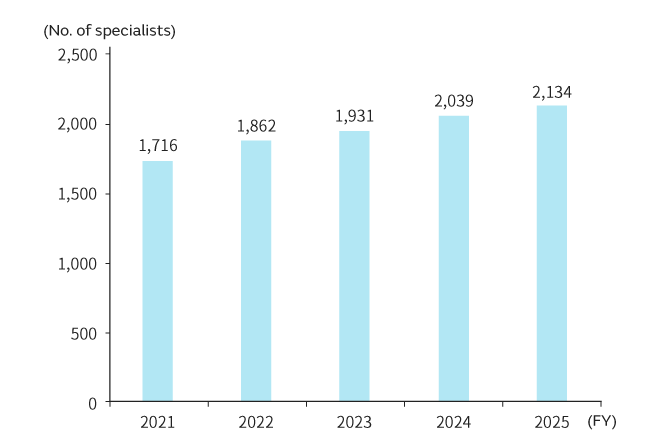 Trend in the number of worksite improvement facilitators
Career support
At Murata, we provide continuous career support so that each employee can actively shape their own career, with the aim of creating a virtuous cycle between individuals and the organization. In addition to support tailored to diverse backgrounds such as job type, age, and mid-career hiring, we support employees' self-directed career development through individual consultations with in-house career consultants.
Multi-track career paths
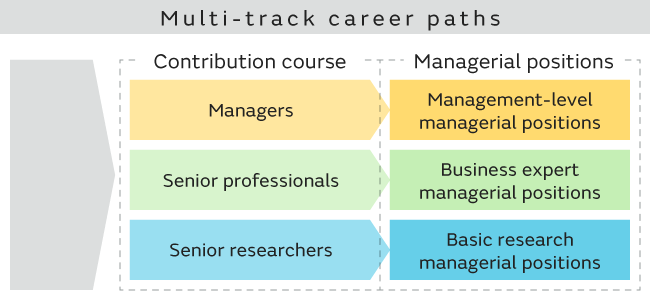
Murata is promoting an expert development system to ensure that personnel contributing to the company with skills developed through advanced expertise and experience are appropriately promoted, assessed, and rewarded.
In Japan, in addition to the “contribution course system” for career-track employees engaged in core operations, we established new higher-level expert managerial positions in 2019 as a framework. At present, many individuals in expert managerial positions are making significant contributions. We are also working toward establishing career paths where employees can perform core operations without having to transfer and change residence, so that our diverse employees can continue to challenge themselves.
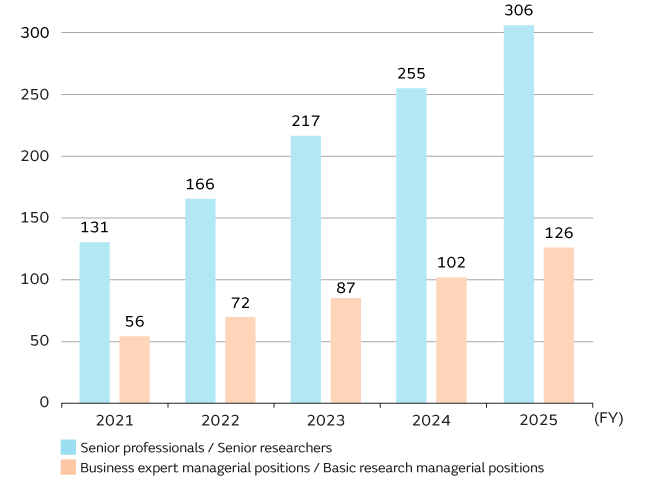
At Murata, we seek to foster diverse perspectives and promote trust and collaboration across departments and locations. In 2021, Murata also established global guidelines for specialist employees (experts) at its overseas Group affiliates, defining their roles, career paths, and required job qualifications. In 2023, we conducted trial training for experts at four of our overseas locations in Europe, and since 2025, we have been holding it in North America as a formal training program for specialist employees called MEXT (Murata Expert Training Program). Going forward, as a venue where specialist employees gather across regions to learn from one another, we also plan to expand it to Japan, Asia, and the ASEAN region.
Support for second careers
Starting in April 2024, Murata Manufacturing and its major affiliates in Japan have implemented an age 65 mandatory retirement system (60 was the age of mandatory retirement age until then) to maximize employee engagement and provide a secure environment in which employees can work with peace of mind until that age. Under this system, employees aged 60 and over remain on the wage scale previously applied up to age 59, with their treatment adjusted to reflect each individual’s level of contribution and role responsibilities. Additionally, we have instituted an “optional retirement system,” which allows each employee to opt for retirement between the ages of 60 and 64, supporting them to make autonomous career decisions.
- Career management training/Career seminar (for employees upon reaching age 50)
- Job matching (internal recruitment system for employees aged 50 and above)
- Workstyle survey (age 57)
- Career change support service
- Preferential early retirement program (for eligible employees aged 45 and over)
Evaluation and compensation
Concept of fair evaluation and compensation
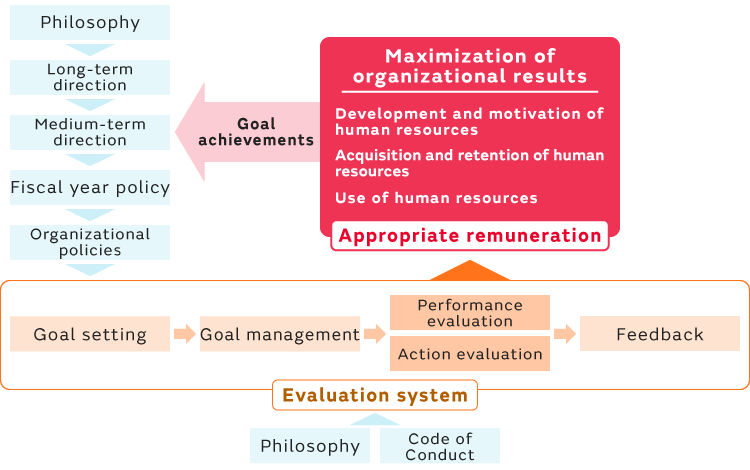
Murata employs fair and objective evaluation processes paired with appropriate compensation and treatment linked to the results. This approach helps us globally achieve “employee development and motivation”, “acquisition and retention of diverse human resources,” and “utilization of human resources.”
- Murata is committed to instilling its corporate philosophy company-wide by embedding the qualities and behaviors it values into its evaluation criteria, establishing standards free from bias related to age, gender, ethnicity or other personal attributes, and making those criteria fully transparent to every employee.
- Fair system operation is guaranteed through continuous improvement, which is supported by periodic evaluator training and mutual feedback mechanisms between labor and management, involving the Murata Manufacturing Workers Union.
- Murata has implemented a standardized employee goal-setting process, requiring employees to meet with their supervisors at the start of each term to set measurable individual goals for the term and ensuring that these goals are aligned with organizational policies.
- During the term, the supervisors track the progress of individual goal achievement and provide timely feedback and guidance on the progress to ensure the fulfillment of both organizational and individual goals.
- Murata evaluates individuals based not only on their job performance, but also on their job conduct and the processes they follow, to ensure that adherence to the corporate philosophy and the Code of Conduct is an integral part of the criteria for their achievements and compensation.
- Evaluations are finalized through multi-faceted performance appraisals conducted by multiple evaluators, ensuring enhanced accuracy and credibility.
- The evaluation process for each employee incorporates feedback meetings with their supervisor, which offer them support for skill development and opportunities for career discussion.
- A performance-linked bonus, which reflects both company performance (by region and by operating company worldwide) and individual performance, is applied to all employees, from management to general staff.
- Through an employee shareholding association and restricted share-based remuneration, we work to heighten employees' awareness of participation in medium- to long-term management and have established mechanisms through which individual contributions are rewarded.
- As a long-term incentive, we have also introduced a retirement benefit program linked to individual performance.
Global leadership competency
Murata has identified eight talent requirements for its leaders (managers), defined as global leadership competencies (GLCs), to drive future innovation. Managers establish annual policies for the organization, and are evaluated based on their progress on these policies and achievements. The GLCs, applied uniformly across all managerial positions, serve as standardized benchmarks to evaluate managerial conduct. Murata is leveraging the GLCs not only to instill its desired talent requirements company-wide, but also to drive its global talent-management initiatives, including development, selection and promotion.
Engagement
Engagement concept
To foster cultural development with the participation of all employees, Murata has embraced “CS and ES” as core values in its management approach. Murata defines ES as “every employee achieving satisfaction and continuing growth through the performance of their work duties,” and the ES status of individual employees is assessed using engagement metrics collected in our annual global survey. Murata aspires to create a virtuous cycle of organizational growth, where improved ES drives higher CS.
Actual performance values
Since 2004, Murata has continued to reform organizational cultures in order to establish a company culture that provides both meaning and opportunities for growth to employees. At Murata, we believe that it is important for employees to feel that their work is meaningful and continue to grow. We therefore have continually been conducting employee surveys at each site in order to determine and analyze issues. Since fiscal 2021, we have been conducting global surveys and running through a global PDCA cycle. The global survey measures aspects such as trust in the company, job satisfaction (including elements like individual development opportunities, access to resources, and learning opportunities), internal motivators (including loyalty and a sense of purpose), as well as respect & recognition. The favorable rate for “employee engagement” has been set as a medium- to long-term benchmark, with a goal of 71% by fiscal 2027 and 76% or higher by fiscal 2030. We have also changed our implementation schedule from once every two years to once a year starting in FY2024 to check and promote activities in shorter cycles and continue taking steps towards achieving our positive employee engagement response ratio targets.
Specific initiatives
To increase engagement and transform it into comprehensive organizational capabilities, we carry out initiatives to promote dialogue, foster collaboration between and within organizations, and instill our corporate philosophy.
Promotion of dialogues between management and employees
At Murata, we believe that it is important to obtain the understanding and agreement of our employees with regard to the company's philosophies, reason for being, and business goals, in order for the company to continue to grow. We will continue to promote dialog between management and employees in order to foster an organizational culture in which employees agree and are satisfied with organizational reform initiatives. Some of these efforts will include:
- Policy explanation sessions conducted by the President
- Dialogues with employee representatives: representatives from 16 domestic sites, the president, and the executive officer responsible for human resources participate in discussions on management policies
- Chitchat with the president (via in-house SNS): shared approximately weekly, with 40 editions distributed in fiscal 2025 encouraging mutual communication
- Training programs led by executive officers: executive officers share Murata philosophy (creed) as lecturers and engage in direct dialogue with employees.
- Began also being implemented at our sites overseas in FY2023
- For our sites overseas, training sessions are a hybrid of in-person and online sessions
- A cumulative total of approximately 400 sessions had been implemented by FY2020
Collaboration initiatives between and within organizations
To improve engagement and strengthen organizational capabilities across the company, each organization advances the PDCA cycle of its organizational development activities and shares its initiatives with other organizations, strengthening collaboration while learning from one another. We also work to strengthen coordination and relationships within organizations, and through these activities we connect the practices of individual organizations to value creation across the entire company.
- Department head workshop
Background: In addition to initiatives within each organization, there is a need to strengthen cross-departmental collaboration and deepen mutual understanding.
Purpose: Starting from dialogue and connections among department heads, to improve human capital and organizational capabilities and, through inter-organizational collaboration, to lead to sustainable value creation and higher engagement.
Details: Centered on the Medium-term Direction, we hold dialogue-based workshops several times a year to co-create an ideal vision, organize issues, and consider measures for realizing an organization where diverse individual abilities are employed. Department heads and senior managers take part, promoting dialogue and collaboration that crosses organizational boundaries.
- Organizational development initiative sharing session
Background: It has become important to share and apply, across the entire company, the organizational development knowledge and practical examples accumulated in each department.
Purpose: Through sharing practical examples and engaging in dialogue, to deepen mutual understanding and foster a rewarding corporate culture and higher engagement.
Details: We hold sessions where each department presents examples of its initiatives and provides a venue for dialogue based on them. We offer broad opportunities to participate in an online format and, through Japanese and English support and archived distribution, promote the global sharing of learning and its continued use.
- Engagement-improvement measures focused on the manufacturing division
Background: It is recognized that the quality of relationships and communication between levels at manufacturing sites has a significant impact on engagement.
Purpose: To strengthen mutual understanding and collaboration on-site, leading to a rewarding workplace environment and higher engagement.
Details: Centered on supervisors at manufacturing sites, we systematically create opportunities, through workshops and other means, to share the initiatives and atmosphere of manufacturing sites both inside and outside the company, promoting dialogue and learning across levels.
A shared understanding of the corporate philosophy to unite diverse individuals
Murata’s organizational and human capitals have been nurtured through a management approach rooted in its corporate philosophy.
It is more important than ever to ensure that all employees share the values that Murata has cultivated.
- Murata Philosophy Month: every October, the month of our founding, is designated as the ‘Murata Philosophy Month’ during which both domestic and global sites organize opportunities for workplace dialogues.
- Murata Philosophy workshop for new employees
- Murata Innovation Museum: a training center where both domestic and global employees deepen their understanding of Murata’s history, corporate creed and management philosophy, and core values, thereby promoting their professional growth. VR and online tours are also available.
- Discover Murata! : a training program offered at the company's headquarters or production sites to help both overseas or local employees understand its corporate creed and philosophy. In fiscal 2025, we held the training twice, with a total of 46 participants.
Work styles and WLB support system that promote challenges and growth (Murata Manufacturing and its major Group Affiliates in Japan)
We are working to develop various systems that help employees achieve a healthy work-life balance.
- Balance support plan that exceeds statutory requirements.
Diverse employees playing active roles
Concept of D,E&I
According to Murata philosophy, our reason for existing is to contribute to the advancement of society, we continue to create innovative products and solutions together with our colleagues and stakeholders by enhancing technologies and skills applying scientific approach. Innovation arises from diverse individuals building trust and working to co-prosper with all stakeholders. At Murata, we have always valued sharing the process of growth and expressing our thanks.
In addition to diversity that can be seen, such as ethnicity, nationality, gender, and age, we recognize that there is diversity that cannot be seen, such as thought, knowledge, experience, and perspective (Diversity). It is not enough to merely have people of various backgrounds, each with their own perspectives and ideas. We must bring those perspectives and ideas out into the open and actively engage them with differing viewpoints and opposing opinions. In environments where majorities and minorities exist, there are often hurdles to expressing diverse ideas and opinions. We therefore put in place infrastructure such as working environments and support systems and foster awareness among employees, so that each of our diverse employees can start from an equal footing (Equity). At Murata, we believe that by engaging in diversity and equity, we create an environment where diverse individuals can demonstrate their abilities, share a common vision, and co-prosper with collaborators (Inclusion).
Specific initiatives
Initiatives to promote diversity of opinions
To foster a D,E&I climate through employee-driven initiatives, we established the Murata Diversity & Inclusion Plaza (M-DIP), a working group of employees selected through open recruitment, and carry out continuous activities across the company and its locations. It began in 2016 and has been active through its eighth term to date, with a cumulative total of 176 participating members. Members gathered from a wide variety of workplaces, transcending roles such as job type and position. Guided by the keyword of making a difference within a "five-meter radius" of their own workplace, they draw on organizational-development know-how to instill D,E&I and to drive innovation that leverages diversity, putting what they learn into practice by taking action in their own workplaces.
Examples)
- Graphic recording course at workplace
- Production of workplace learning videos on topics such as unconscious bias and assertive communication.
- Practice of D,E&I dialogue at multiple workplaces utilizing facilitation skills
SOGIE
At Murata, based on the concept of D,E&I, we are creating an environment where people can work comfortably regardless of their SOGIE (Sexual Orientation & Gender Identity, Expression) status.
| Basic policy |
In our Human Rights Policy, Corporate Ethics Policy, and Code of Conduct, Murata declares prohibition of discrimination and harassment based on sexual orientation, gender identity, and expression. |
| Training and seminars |
Since fiscal 2020, we have held these sessions regularly, roughly every fiscal year.
In addition to company-wide seminars, many dialogue meetings on the topic of gender diversity are held at individual workplaces and business sites.
|
| Internal HR regulation |
Since April 2022, Murata has clearly stated to apply the same internal regulation, including welfare and benefit programs, as those for legal marital relationships, to same-sex partners and common-law partners, which have already been used by some employees. |
| Expanding the circle of allies |
A growing number of employees are declaring themselves allies who show understanding and engage in dialogue. We actively communicate this, for example by distributing original stickers. |
| Accessible internal equipment and supplies |
We have universal use toilets. The gender-distinguished uniform is changed to a unitary design. |
| Approachable contacts |
In addition to the consultation desk at each business site, each contact accepts consultation requests regarding SOGIE.
An event hosting individual consultations with external specialists was held during fiscal 2023.
|
| Dialogs with stakeholders |
Each year, to coincide with Pride Month in June, Murata Manufacturing lights up its headquarters building.
In fiscal 2023, we held a dialogue meeting with the certified NPO Nijiiro Diversity.
In fiscal 2025, we sponsored PRIDE in KYOTO, an event that connects LGBTQ+ people and allies.
|
Promoting women's participation and advancement (toward a state where everyone can balance work and life and thrive, regardless of gender)
At Murata, we aim to be a workplace where everyone, regardless of gender, can develop their skills through experience and push one another to grow. Murata Manufacturing has set targets for the ratio of women in its recruitment of new-graduate technical career-track hires, the ratio of women in managerial positions, and the rate at which men take childcare leave and is working to realize a diverse workplace. We also promote communication in the workplace by building networks of female supervisors across our business sites and by holding a women's health seminar every year on International Women's Day.
The rate at which men take childcare leave was 87% in fiscal 2025, against a target of 85% by the end of fiscal 2026 (averaging 55.4 days taken). Including the rate at which employees whose spouse has given birth take special paid leave for childcare purposes, the figure is 93.4%, showing that we have created an environment where work and childcare can be balanced regardless of gender.
The average gender pay gap is as follows.
- FY2025 Murata Manufacturing alone
We are working to close the pay gap as follows.
To raise the ratio of women in managerial positions in particular, we are advancing initiatives that span our business sites toward diversifying our decision-making levels, through measures such as formulating succession plans, eliminating unconscious bias, and offering the WAVE (Women Accelerating Voices & Empowerment) career training program for candidates.
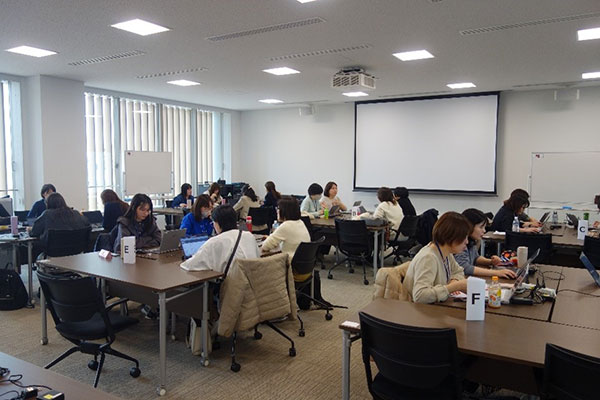 A scene from WAVE (Women Accelerating Voices & Empowerment)
Throughout the year, we provide career development support and networking opportunities to foster motivation for growth, and, among participants in the fiscal 2025 training program, the proportion aspiring to managerial positions rose to 76%.
Promotion of participation of persons with disabilities
Murata is committed to expanding employment opportunities and improving workplace environments to create an inclusive atmosphere where diverse individuals, with or without disabilities, can thrive and continue working with vitality.
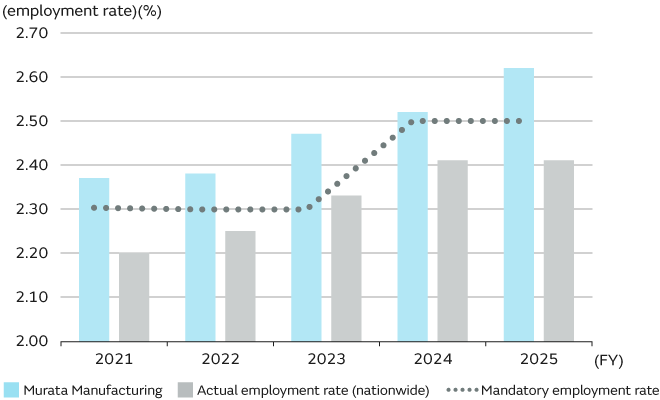 Proportion of Disabilities Employed at Murata Manufacturing Co., Ltd
- Actual employment rate: based on the Ministry of Health, Labor and Welfare’s results of the statistics on the employment of disabilities
In 2020, we established a special subsidiary called Murata Cosmos. With offices in our group companies, we aim to expand work opportunities outside of manufacturing work, such as cleaning offices, washing cleaning uniforms, and operating company cafés. We also continue to offer farm-based employement and other opportunities that enable individuals to play an active role in a manner which is both mentally and physically healthy.
Alongside expanding employment opportunities, we are making concerted efforts to hold regular meetings and to provide reasonable accommodations tailored to each individual’s circumstances, as part of creating a work environment in which all employees, with or without disabilities, can work with confidence and peace of mind. We have implemented workplace adaptations designed to foster a supportive environment where individuals can better focus on their work. Tailored to individual characteristics or insights gained from interviews, these adaptations include displaying daily schedules and introducing color-coded zones for pathways and work areas.
Additionally, the employment rate of people with disabilities at our overseas group companies is 0.2%, and we are undertaking initiatives in accordance with the applicable laws and regulations in each country and region.