Murata's reliability technology has advanced by adapting standard methodologies to products centered on Multilayer Ceramic Capacitors (MLCC). In recent years, product diversification, miniaturization, and increased precision, coupled with increasingly varied usage environments in the market, have made estimating failure mechanisms more difficult. To address this, it is essential to ensure the quantitative nature of measurements and to develop testing technologies with high reproducibility of failure modes. In response to these changes, failure analysis technology, reliability testing technology, and calibration technology have each evolved.
Failure Analysis Technology: This technology focuses on accurately identifying failure states inside products through cross-sectional polishing techniques. While extensive technical knowledge has been accumulated, primarily for multilayer ceramic capacitors, there was a challenge: results varied due to dependence on human perception and equipment specifications. Therefore, we have advanced the technology to quantitatively assess polishing damage during destructive analysis, design optimal conditions to reveal undamaged failure surfaces, and ensure consistent analysis results regardless of personnel or equipment.
Reliability Testing Technology: This technology ensures reliability by applying appropriate and well-controlled stress to test samples. For instance, to reduce variations in temperature and humidity stress within test chambers, we manage sample placement positions based on public standards and customer requirements to ensure stress remains within acceptable limits. Furthermore, for condensation testing, we have advanced our technology to reproduce stable condensation conditions by performing preliminary evaluations using condensation sensors and setting conditions according to the size of the sample.
Calibration Technology: This technology focuses on establishing calibration methods that minimize measurement uncertainty. Traditionally, humidity conversion using the JIS Z 8086 psychrometer involved utilizing the temperature difference between the dry and wet bulbs, which presented the challenge of high uncertainty. To resolve this, we established a method for high-precision calibration of temperature and humidity sensors. By using this method to directly calibrate the temperature and humidity inside the chamber, we have significantly reduced uncertainty.
In this way, continuously pursuing quantifiability and reproducibility in each core technology drives the shift towards “proactive reliability technology that predicts and prevents failures before they occur.” This further strengthens Murata's reliability evaluation foundation and leads to future improvements in product quality.
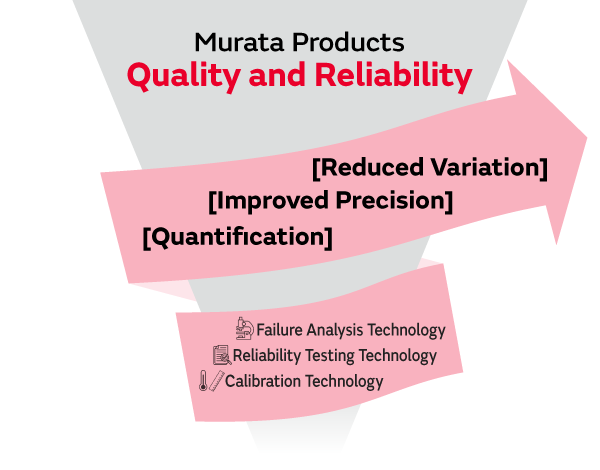 Evolution of Reliability Technology Through Pursuit of Quantifiability and Reproducibility