The strength of Murata's Circuit substrate design technology lies in its ability to accommodate diverse modules tailored for different markets, achieved through layout design techniques that incorporate peripheral technologies accumulated via the development of various modules.
In addition to general printed wiring boards (PWBs), Murata's circuit substrate design technology maximizes the features of circuit substrates such as self-developed and manufactured multilayer ceramic substrates (LTCC) and multilayer LCP products, as well as advanced packaging technologies, creating the uniqueness of Murata's module products.
To achieve this, Murata uses CAE tools to analyze and verify how the physical properties of substrate materials and manufacturing processes impact the electrical and physical performance of module products. It optimizes the substrate structure (number of layers and thickness), component placement, and wiring routes based on relationships with design rules and manufacturing rules.
Moreover, by working on and utilizing cutting-edge technologies at an early stage in parallel with the development of peripheral technologies, Murata feeds back the advantages and disadvantages from the perspective of circuit substrate design to related technical departments. This approach emphasizes a balanced perspective in manufacturing practices.
Thus, the accumulation and optimization of layout design techniques that take peripheral technologies into account characterize Murata's Circuit substrate design technology and serve as a key strength supporting the competitiveness of its extensive range of module products.
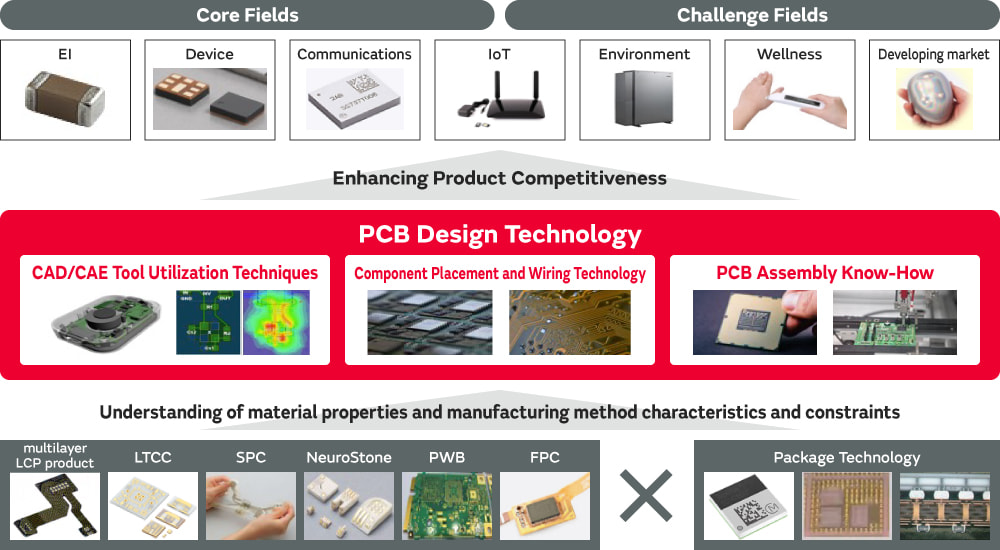 Strengths of Murata's circuit substrate design technology