Technical Explanation
Murata's battery device design technology extends beyond the design of battery devices, including materials, to encompass module technology that combines and controls multiple batteries, as well as the development of technologies that manage the entire system. Consequently, a key feature is its broad range of technologies, spanning from the battery itself to peripheral technologies.
Specifically, building on the material technology of the world's first successfully commercialized lithium-ion rechargeable battery, Murata develops diverse technologies: battery design to enhance cell characteristics, and battery modules, battery systems, and energy storage systems to maximize battery performance.
We also place great emphasis on safety design through advanced material technology, design expertise, and circuit and control design. Our “integration technology,” which unifies these technologies, enhances reliability and safety, enabling us to meet diverse applications and market needs.
Particularly, our olivine-type lithium iron phosphate secondary battery (FORTELION), which demands long-term reliability, has a proven track record of over 15 years since its commercialization and has received high praise from our customers.
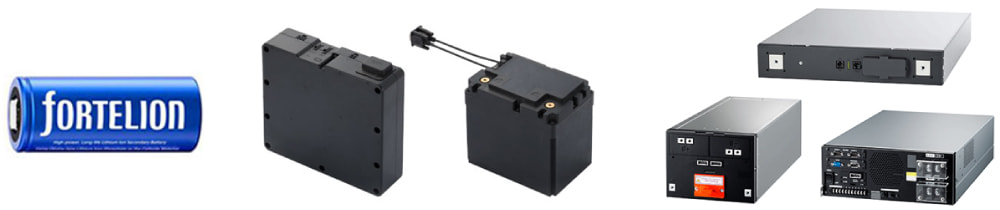 Olivine-type Lithium Iron Phosphate Secondary Battery (FORTERION) and Battery Module / System
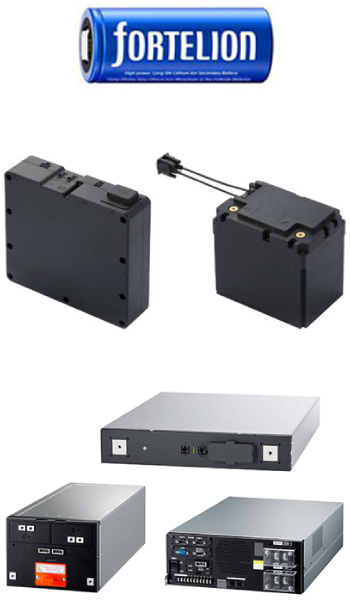 Olivine-type Lithium Iron Phosphate Secondary Battery (FORTERION) and Battery Module / System
Technological Strengths
Murata's strength in battery device design lies in its unique approach to achieving a balanced combination of high capacity, high output, and long life in lithium-ion rechargeable batteries.
In particular, addressing the issue of lithium-ion battery fires—a growing societal concern in recent years—we have been tackling this challenge for approximately 30 years. This has led to the commercialization of polymer batteries using highly safe gel electrolytes and FORTELION, featuring lithium iron olivine phosphate cathode material with excellent thermal stability. This involved a major overhaul of materials and manufacturing methods, such as switching to polymer electrolytes that prevent leakage and have a high flash point, and changing the cathode firing process from an oxidizing atmosphere to a reducing atmosphere. While this challenge involved significant difficulties, our commitment to addressing these issues remains unchanged. These core technologies are also leveraged in high-output lithium-ion rechargeable batteries for power tools and garden tools.
Furthermore, for battery modules, we employ optimal circuit control technology and low-resistance technology to maximize the performance of each cell. The entire system features precise monitoring via a BMS (Battery Management System) and multiple safety functions. This enables us to respond swiftly and accurately to diverse market needs, providing long-life, highly reliable, and highly efficient battery solutions for applications ranging from consumer to industrial use.
 Electrolyte for polymer batteries
FORTELION Olivine-Type Lithium Iron Phosphate Cathode
Technological Advancement
Murata's battery device design technology has continuously advanced the high capacity, high output, and long life of lithium-ion rechargeable batteries, evolving material development and design techniques. As a result, we have commercialized numerous world-first technologies.
For example, in cylindrical batteries, the initial commercial capacity was 0.9Ah. Through the adoption of the world's first nickel-based cathodes and non-graphite anode technology, it now exceeds 4Ah. Maximum output has also significantly increased from the initial few amperes to 50A in the latest NCA (Nickel Cobalt Aluminum Oxide) type VX40. We are also actively advancing technological innovations aimed at miniaturization, weight reduction, and higher efficiency for modules and systems. Furthermore, we are strengthening co-creation with partner companies and research institutions. For example, we are developing electrode material technology for porous current collectors that achieves four times the output characteristics compared to conventional ones. Beyond these new technologies for cylindrical lithium-ion secondary batteries, we are also focusing on developing next-generation batteries, particularly all-solid-state batteries, leveraging Murata's MLCC (Multi-Layer Ceramic Capacitor) technology. Through these efforts, we aim to further expand applications and enhance performance towards realizing a sustainable society.
Murata's Lithium-Ion Rechargeable Battery