Production Technology Heat Treatment Technology

Heat Treatment Technology icon

Summary

  • General heat treatment technology refers to processing methods that apply heat to materials or components in order to alter their properties and performance.
  • Murata’s heat treatment technology goes beyond simply applying heat.
    It treats heat treatment equipment as reaction vessels and places emphasis on controlling the chemical reactions that occur inside the equipment.
    This technology is mainly used in processes such as debinding, firing, and outer electrode firing of ceramic components.
  • Murata’s heat treatment technology is a critical technique in which ceramic and metal powders are first formed, then binders are removed at low temperatures, and finally the materials are sintered at high temperatures to achieve the optimal crystalline state.
    This technology consists of four elements: process technology, equipment design, tooling technology, and material handling technology.
    By optimizing temperature and atmosphere control, tooling material selection and placement, and product conveyance, Murata contributes to new product creation and improved productivity.
  • Because development is carried out through a vertically integrated approach, Murata can provide optimal heat treatment tailored to each material and product in close collaboration with development and production departments.
    This integrated capability is a key strength.
    Murata also owns extensive thermal analysis technologies and dedicated equipment, enabling design proposals and on-site problem solving.
  • In response to trends such as thinner layers, smaller sizes, and mass production, Murata has evolved its heat treatment technology over time.
    Moving beyond trial-and-error approaches, Murata now understands phenomena occurring during heat treatment and effectively utilizes simulation technologies to develop process methods and equipment based on scientific evidence.
    In addition, Murata is committed to reducing environmental impact, achieving high quality, high reliability, and environmental responsibility at the same time, and realizing sustainable Monozukuri.
  • This technology is applied to the production of many Murata ceramic electronic components, including Multilayer Ceramic Capacitor (MLCC), EMI products, piezoelectric products, and multilayer products.

Murata's Heat Treatment Technology

Technical Explanation

Murata’s heat treatment technology is a key technology that understands the thermal environment required for each material and creates that environment in order to maximize material performance.
It is one of the most critical technologies for imparting functionality to electronic components.

Major electronic components are produced by mixing ceramic powders—mainly BaTiO3 (barium titanate) and ferrite—or metal powders—mainly Ni (nickel), Ag (silver), and Cu (copper)—with binders and solvents, and then forming them into specified shapes.
To bring out the required component characteristics, unwanted binders and solvents must be decomposed and removed at low temperatures, and the ceramic must then be sintered at high temperatures to form the desired crystalline structure.
This series of steps is referred to as the heat treatment process.

Murata’s heat treatment technology consists of heat treatment process technology, heat treatment equipment design and manufacturing technology, tooling technology, and material handling technology.

Heat treatment process technology: This technology establishes optimal conditions by fully understanding material and product characteristics, including not only temperature control but also atmosphere control.
This maximizes the performance of each product.

Heat Treatment Equipment Design and Manufacturing Technology: This technology realizes the optimal conditions derived from process technology by implementing them in actual furnaces.
It requires mechanical designs that precisely control temperature and atmosphere, as well as structural designs that balance durability and energy efficiency.

Tooling technology: This technology covers dish-shaped jigs used when loading products into furnaces.
Because these tooling materials may come into direct contact with products and are repeatedly exposed to high temperatures, advanced know-how is required for selecting appropriate materials and shapes.
In addition, product placement on the tooling is a critical factor for improving productivity and preventing defects and variations.

Material handling technology: This technology uses automated control to accurately and efficiently transport products to designated positions.
This technology ensures uniformity and stability in the heat treatment process and maintains consistent quality even in mass production.
Murata’s heat treatment process and the technologies that support it

Technological Strengths

The greatest strength of Murata’s heat treatment technology lies in its ability to provide the most suitable heat treatment method for specific material and product characteristics.
This capability is rooted in close collaboration with in-house development departments from the early stages of development, enabling a deep understanding of material and product properties.
Murata possesses numerous proprietary thermal analysis technologies and devices capable of analyzing the chemical reactions and physical changes that occur during heat treatment.
The knowledge obtained from these analyses is accumulated and translated into production equipment and fixtures that can precisely control temperature and atmosphere.
In addition, from the perspective of heat treatment, Murata proposes changes to structures and specifications that facilitate heat treatment to material and product design departments.
By working closely with each development department, Murata maximizes the effectiveness of heat treatment technology and contributes to the timely creation of new products.

Furthermore, challenges and improvement requests from production sites are shared openly with development teams.
This enables comprehensive problem solving from both process and equipment perspectives.
Through this collaborative approach, Murata continuously improves its processes and equipment, achieving high-quality and stable production.

Providing the optimal heat treatment method for material and product characteristics

Technological Advancement

Murata’s heat treatment technology has evolved toward increasingly complex and precise control so as to minimize the effects of the heat treatment environment as products have become thinner and smaller.
At the same time, as production volumes have increased, Murata has established systems capable of processing millions of products in a single heat treatment cycle with minimal variation.

In the past, it was difficult to directly observe changes occurring inside sealed, high-temperature kilns, so conditions were explored through repeated evaluation of products after heat treatment.
However, through Murata’s proprietary thermal analysis technologies and equipment development, it has become possible to capture in-situ changes during the heat treatment process.
This allows issues to be clearly identified and ideal conditions to be extracted.
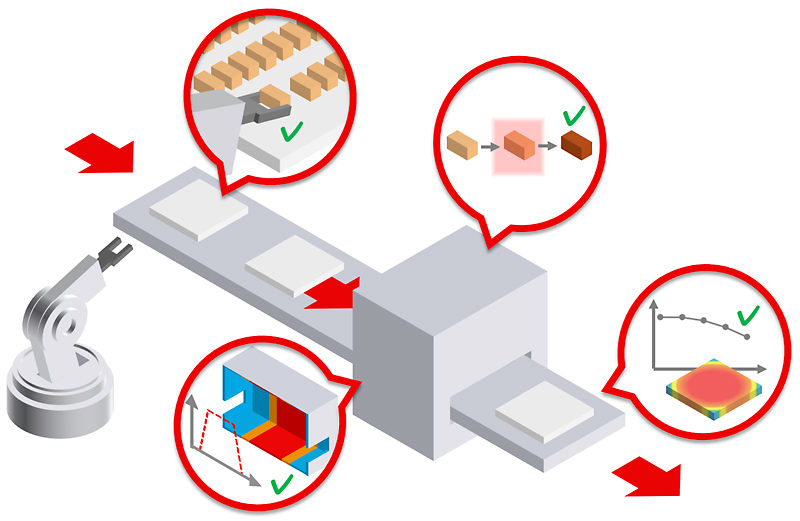
Murata also uses simulation technologies to analyze kiln thermal distortion, temperature distribution, gas flow, and reaction states in advance.
By reflecting these results in equipment design, Murata achieves highly precise control of temperature and atmosphere, realizing its own distinctive heat treatment methods.

In addition, from the perspective of reducing environmental impact, Murata promotes energy conservation and introduces high-efficiency kilns and energy recycling technologies.
Through these efforts, Murata achieves both high quality and high reliability while advancing sustainable Monozukuri.

The evolution of Murata’s heat treatment technology

See here for related Murata technologies.

Examples of Heat Treatment Technology Application ~Product Introduction~

Technology