Materials Technology Inorganic Materials Technology

Inorganic Materials Technology icon

Summary

  • Generally, inorganic materials technology refers to techniques for controlling the structure and composition of inorganic materials such as metal oxides, nitrides, and ferrites to achieve desired electrical, magnetic, and mechanical properties.
  • Murata's inorganic materials technology spans a wide range, including dielectric ceramics for Multilayer Ceramic Capacitor (MLCC), piezoelectric materials, semiconductor materials, and magnetic materials.
  • Murata's strength in inorganic materials technology lies in precisely controlling the particle size, composition, and microstructure of ceramic materials using proprietary techniques, enabling the realization of high-performance, highly reliable electronic components. For representative BaTiO3 (barium titanate) dielectric materials, electrical properties and heat resistance are enhanced through processes like micronization and firing, along with optimization of the core-shell structure. This contributes to the miniaturization and increased capacitance of Multilayer Ceramic Capacitor.
  • Murata's inorganic material technology supports the miniaturization and increased capacitance of Multilayer Ceramic Capacitor by contributing to the thinning and multilayering of dielectric elements and Ni (nickel) internal electrodes. Material miniaturization and homogenization ensure reliability, with dielectric designs featuring reduction resistance being particularly crucial for Ni electrode adoption. Advances in material technology, such as powder refinement and surface smoothing during sheet forming, enable enhanced product performance.

Murata's Inorganic Materials Technology

Technical Explanation

Murata's inorganic material technology handles diverse ceramic materials such as dielectrics, piezoelectrics, semiconductors, and magnetic materials, enabling the realization of high-performance, highly reliable electronic components through proprietary technologies.

Dielectric Material Technology: Utilizing materials such as barium titanate (BaTiO3) with high dielectric constant, it forms the dielectric layer of Multilayer Ceramic Capacitor. This layer is a critical core material determining the capacitor's capacitance and voltage withstand characteristics.

Piezoelectric Material Technology: This technology possesses the function of converting pressure or vibration into electrical signals, or converting electrical signals into mechanical vibration. Piezoelectric materials such as lead zirconate titanate (PZT) are used, with piezoelectric characteristics and temperature characteristics designed to suit the application. It provides essential functionality for applications like ultrasonic distance sensors and precision control microactuators.

Semiconductor Material Technology: Its electrical resistance changes in response to external environmental factors like temperature and voltage. It converts physical signals into electrical signals. Semiconductor ceramics (e.g., oxides for NTC (Negative Temperature Coefficient) thermistors) enable high-precision temperature measurement through precise control of material composition. They are widely used for sensing and control applications in automotive, industrial, and medical fields.

Magnetic Material Technology: Utilizes magnetic properties for energy conversion and noise suppression. Focusing on ferrite-based magnetic materials, we optimize permeability, saturation flux density, and loss characteristics for specific applications. Achieves high-efficiency power conversion and high-frequency noise reduction in inductors and EMI (electromagnetic interference) suppression filters.
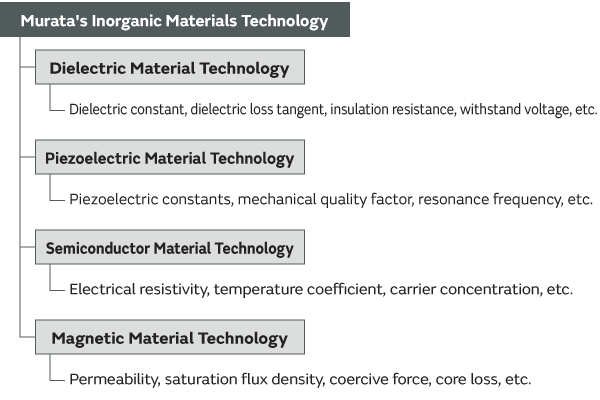
System Diagram of Murata's Inorganic Materials Technology

Technological Strengths

Murata's strength in inorganic materials technology lies in its ability to precisely control the particle size, composition, and microstructure of diverse ceramic materials using proprietary techniques. This enables the creation of high-performance, highly reliable electronic components.

A prime example is the barium titanate (BaTiO3) dielectric ceramic used in Multilayer Ceramic Capacitor. This material is processed by micronizing high-purity powder to submicron levels, followed by press forming or sheet forming. It is then sintered in precisely controlled furnaces to achieve densification and homogenization, ensuring stable electrical properties and heat resistance.

A key characteristic is the core-shell structure within the ceramic particles, consisting of a ferroelectric core surrounded by a non-ferroelectric shell. Additives are solid-solved into the shell, and the volume ratio between the shell and core significantly influences material properties. Optimizing firing conditions and additive quantities enables enhanced properties. For example, solid solution of the rare earth element Dy (dysprosium) in the shell flattens the temperature characteristics of capacitance and extends component lifespan.

Such advanced microstructure control technologies, including this core-shell structure, play an indispensable role in achieving thinner layers and higher capacitance in Multilayer Ceramic Capacitor.

Diagram of Core-Shell Structure
Figure: Elemental Technologies for Material Design and Microstructure Control
Elemental Technologies for Material Design and Microstructure Control

Technological Advancement

Murata's inorganic material technology has driven the miniaturization and increased capacitance of Multilayer Ceramic Capacitor. Supporting this evolution are technologies for thin-film and multilayer formation of dielectric elements and Ni internal electrodes. Achieving these requires the essential miniaturization and homogenization of the dielectric and internal electrode materials themselves.

During the thin-film process, challenges such as inhomogeneity and the occurrence of abnormal areas became apparent. However, by continuously improving microfabrication and homogenization technologies to enhance material quality, we have ensured reliability. Crucially, designing dielectric materials with high resistance to reduction became key to adopting low-cost Ni internal electrodes.

Furthermore, the evolution of all material technologies constituting Multilayer Ceramic Capacitor—including the refinement and homogenization of dielectric and Ni powders, and the smoothing of substrate surfaces during dielectric sheet forming—has enabled dramatic improvements in product performance.

Thinning and Multilayering Technologies for Dielectric Layers and Ni Internal Electrodes
Evolution of Dielectric Layers/Ni Powder for MLCC Miniaturization and High Capacitance

Application examples for this technology

*Link to the product information site.

See here for related Murata technologies.

Examples of Inorganic Materials Technology Application ~Product Introduction~

Technology