Production Technology IE (Industrial Engineering) Technology

IE (Industrial Engineering) Technology icon

Summary

  • Generally, Industrial Engineering (IE) Technology is a management technique that integrates “people, machinery, materials, and information” to build optimal work systems for manufacturing processes spanning planning, design, production, and logistics.
  • Murata's IE Technology spans both the Engineering Chain Management (ECM) axis (from planning and design to production line construction) and the Supply Chain Management (SCM) axis (from material procurement to customer delivery). By leveraging management techniques that integrate “people, machinery, materials, and information,” we build optimal work systems company-wide. In this way, we support the strengthening of Murata’s manufacturing as a “strategic partner in manufacturing.” In this way, we support the strengthening of Murata’s manufacturing as a “strategic partner in manufacturing.”
  • Beginning with rationalization activities in the 1960s, it evolved through the introduction of high-mix low-volume production, JIT (Just-in-Time), and VE (Value Engineering), and in recent years has advanced to production innovation utilizing DX (Digital Transformation) and AI (Artificial Intelligence).
  • We promote autonomous improvement at the shop floor level through the Field Improvement Specialist system and rigorous implementation of the PDCA (Plan-Do-Check-Action) cycle. Furthermore, we enhance productivity and quality by applying scientific methods such as flow production, standardized work, and input leveling.

Murata's IE (Industrial Engineering) technology

Technical Explanation

Murata's IE Technology integrates “people, machines, materials, and information” across both the ECM and SCM axes. Using this management technology, we build optimal work systems company-wide. To maximize value for customers with minimal capital, we take a scientific approach covering everything from production line design and planning to implementation and improvement.

On the ECM axis, we bridge business and manufacturing. We identify factory management issues using profit and loss management and cost management, then design manufacturing systems to address them.

On the SCM axis, we embed improvement methodologies into the workplace, driving productivity gains through flow creation and standardized work, while optimizing overall logistics.

At the operational level, we reduce worker burden by considering both physical and psychological stress. In layout design, we shorten movement paths based on the “streamlining” of people and materials. For equipment, we enhance efficiency by leveraging proprietary technologies. Regarding quality, we improve yield rates using mass production data.

We conduct cost planning from the product planning stage to streamline new process design and equipment investment.

For high-mix, low-volume production, we reduce lead times by shortening setup times and adjusting line balance. Furthermore, we stabilize quality by minimizing work variation through establishing and training on standard work procedures.

By integrating these technologies, we build a production system that achieves both reduced manufacturing costs and flexible adaptation to market changes.
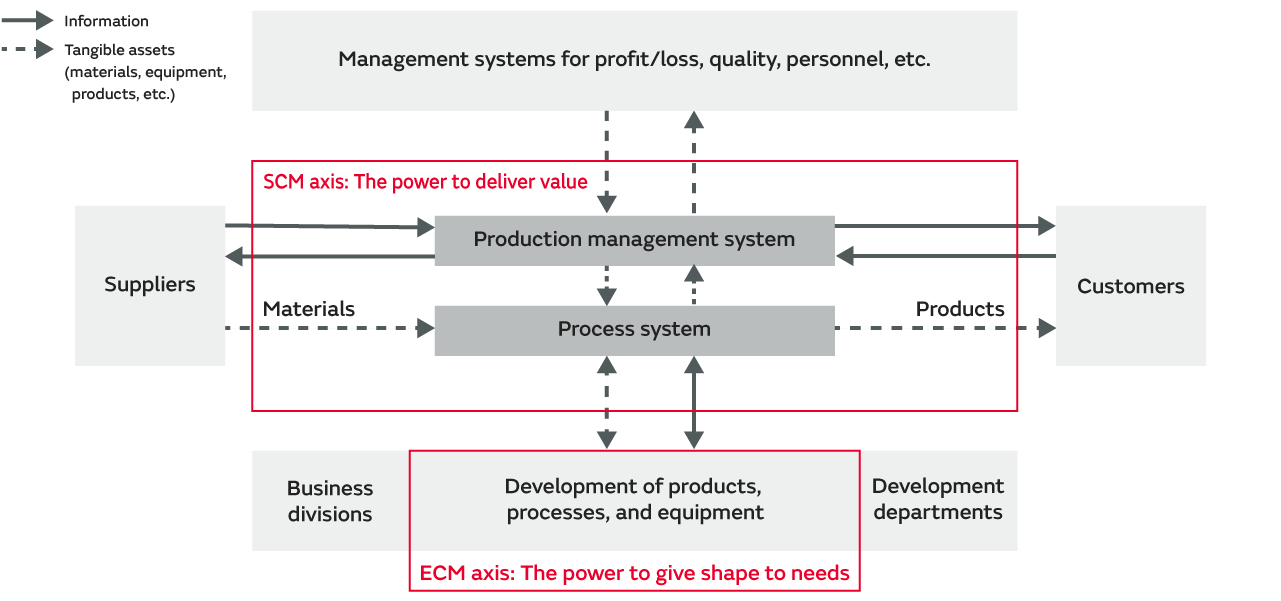
Manufacturing domain (ECM axis, SCM axis)

Technological Strengths

Murata's IE Technology program cultivates improvement specialists through accumulated technical expertise and the education and development of frontline workers. A key initiative is the “On-Site Improvement Specialist System.” This internal certification program recognizes individuals who master IE methodologies and can independently execute the PDCA cycle of improvement as specialists. Currently, approximately 2,000 Improvement Specialists autonomously drive the PDCA cycle, fostering a culture that generates annual cost savings of about one billion yen. This culture has spread throughout the entire manufacturing site, promoting autonomous improvement activities. Guided by the value of “pursuing labor productivity per worker,” Improvement Specialists work to realize smooth flow, thoroughly implement standardized work, and eliminate overburden, unevenness, and waste, thereby achieving stable production.

Furthermore, we actively introduce DX and AI, such as input leveling using genetic algorithms and process design utilizing simulation. This enhances planning accuracy and productivity while dramatically accelerating the pace of improvement. As a result, we have built a robust production system that simultaneously achieves sustained competitive strength and reduces the burden on the shop floor.

Number of On-Site Improvement Specialists (Consolidated)

Technological Advancement

Murata's IE Technology began in the 1960s with “point” improvements such as setup reduction and increased operating rates. It then evolved into ‘line’ improvements like rationalization and production line integration. During the 1970s and 1980s, it expanded to “area” improvements including layout design and manufacturing system design.

As the electronic components market expanded and high-mix, low-volume production accelerated, Murata further strengthened its production system in the 1980s with a focus on balancing responsiveness to customer-specific requirements with production efficiency. In the latter half of the 1980s, it introduced Value Engineering (VE), adopted JIT (Just-in-Time) streamlining techniques, and incorporated “Manufacturing Profitability Management” activities that link production and management.

From the 1990s onward, IE Technology was systematized through the introduction of data mining and optimal input/allocation systems. Since the 2010s, DX has advanced using robotics-based FA (Factory Automation) and AI technology. This approach achieves both efficiency and high-quality product manufacturing.

Moving forward, we will utilize these smart technologies through Cyber-Physical Systems (CPS) to prevent defective products and production losses in real time and to pursue fundamental solutions to root causes. We will promote smooth flow and flexible automation to realize highly efficient production capable of handling high-mix production as well as variable product types and production volumes. Through thorough cost reduction and improved capital efficiency, we will continue advancing IE technology.

Timeline of IE Technology Evolution
Thorough Cost Reduction and Capital Efficiency Improvement through DX/Smart Technology Utilization

Application examples for this technology

In our core businesses, including Multilayer Ceramic Capacitor (MLCC), we combine technological evolution with an autonomous PDCA culture to enhance competitiveness through rigorous cost reduction. As production expands, we optimize logistics and promote flow within factories to build waste-free production processes. In establishing new factories and launching overseas plants, IE Technology contributes through profit improvement, production line design, and rapid worker training.

For products with short lifecycles, we implement profit/loss and cost management even before market launch. We generate profits through rapid vertical ramp-up.

Examples of IE (Industrial Engineering) Technology Application ~Product Introduction~

Technology