Production Technology Precision Processing Technology

Precision Processing Technology icon

Summary

  • Generally, precision machining technology refers to processing techniques that achieve extremely high dimensional accuracy and surface quality in the manufacture of mechanical and electronic components.
  • Murata's precision machining technology is a differentiating factor in electronic component manufacturing. We have advanced four core technologies-metal stamping, resin molding, machining, and laser processing-in specialized areas focused on forming small, intricate shapes and materials used in components. This enables high-precision machining at the micron-level and even the nano-level, while simultaneously achieving high productivity.
  • These technologies contribute to the miniaturization and enhanced performance of electronic components such as multilayer ceramic capacitors, EMI (electromagnetic interference) countermeasure products, and high-frequency connectors.

Murata's Precision Processing Technology

Technical Explanation

Murata's precision processing technology consists of four core techniques: metal stamping, resin molding, machining, and laser processing.
These technologies enable manufacturing that achieves both micron-level to nano-level high-precision processing and high productivity in the field of equipment for producing small, thin electronic components.

  • Metal Stamping Technology: Metal stamping technology is a processing method that shapes metal sheets by applying high pressure. It is widely used for mass production of parts and when high dimensional accuracy is required. It can also produce complex shapes and fine holes. In the electronic component field, it is an indispensable technology for mass-producing thin, finely shaped parts such as terminals and housing components.
  • Resin Molding Technology: Resin molding technology involves injecting molten resin into a mold, then cooling and hardening it to form the part. Processes like injection molding and transfer molding enable the mass production of complex three-dimensional shapes and microstructures in a single operation.
    In electronic components, it is used for insulating materials and exterior parts. These two processing technologies are not only used individually but also combined to create hybrid structures integrating metal and resin.
  • Machining Technology: Machining technology involves shaping materials using cutting or grinding tools to achieve extremely high precision in dimensions and form. Molds, jigs, fixtures, and equipment parts used in electronic component manufacturing are produced through this process. Required precision often reaches the micron-level or below, and surface smoothness is also critical.
  • Laser Processing Technology: Laser processing technology uses concentrated high-energy laser beams to perform cutting, drilling, surface modification, and microstructure formation. Being a non-contact process, it minimizes deformation from heat or force, making it ideal for processing fine patterns and thin films.

These technologies play a vital role in product groups where microstructures directly impact performance, such as sensors, connectivity components, and high-frequency devices.

Murata's Precision Machining Technology Fields

Technological Strengths

Murata's precision machining technology excels in high-precision processing within the micro and fine-scale domains. By combining advanced adaptability to production equipment and molds with precision finishing at the semi-finished stage and close coordination with product design, we create high added value that competitors find difficult to replicate.

  • Metal Press Processing Technology / Resin Molding Technology: To meet the demand for smaller and thinner electronic components, we have advanced our mold design technology for intricate shapes and enhanced the precision control of molding conditions. For example, in high-frequency connectors combining multiple metal and resin parts within a few millimeters, the required machining precision for each part is measured in microns. Therefore, we conduct manufacturing alignment from the design stage, utilizing high-precision molds designed in-house and assembly methods that stably maintain positional accuracy. This achieves both high density and miniaturization.
    Furthermore, we develop compact units specialized for functions in small, fine products and build compact production lines where these units can be freely reconfigured. This enables high productivity and flexible product variety response.
  • Machining Technology: In machining technology, we have established proprietary techniques for high-precision machining of key in-house equipment components and molds essential for manufacturing small, fine electronic components. We are also committed to passing down this technology.
    Through coordination with the design department, we clearly define the required precision levels for equipment performance, ranging from microns to nano. We apply advanced control technology that minimizes tool runout to under 0.2µm and wear to under 0.1µm, while maximizing the capabilities of the latest machining equipment.
    Furthermore, we have established a feedback loop using 3D measurement and non-contact shape evaluation systems. This ensures stable precision is maintained even during mass production, enabling us to consistently supply high-quality molds and structural components that are critical to the performance of electronic components.
  • Laser Processing Technology: For laser processing technology, we optimize laser oscillator specifications according to product materials and intended applications such as separation, joining, and peeling. Furthermore, beam control technology enables high-quality processing. By optimizing pulse width, output, and wavelength according to material characteristics, we achieve both high processing speed and precision for electronic components undergoing miniaturization and increasing functionality.
    Furthermore, we combine our proprietary laser branching technology with optimized optics and irradiation control technology. This enables ultra-high-speed processing, such as drilling tens of thousands of holes per second in ceramic sheet processing. These laser processing technologies play a crucial role in the production of product groups where micro-processing directly impacts performance.
Precision machining technology plays a key role within Murata's manufacturing process.

Technological Advancement

Murata's precision machining technology has been cultivated since the company's founding and has evolved as the foundation of its manufacturing. Alongside the progress in miniaturization and increased functionality of electronic components, semi-finished products and jigs produced using molds have developed through repeated refinement toward finer details and higher precision.
Initially, the company relied on commercially available equipment for metal press processing and resin molding. However, as electronic components became smaller, higher precision was increasingly demanded, particularly for molds. In response, Murata established machining technology and applied it to key parts and jigs for in-house equipment. This contributed to enhancing the precision of the entire manufacturing process.

By the late 1990s, the establishment of machining technology also advanced metal press forming and resin molding techniques. Moving beyond standard commercial equipment, Murata developed specialized equipment tailored for electronic component manufacturing, achieving significant productivity gains. Entering the 2000s, challenges emerged where contact-based machining could not meet production capacity demands in fields like ceramic processing. Consequently, we introduced non-contact laser processing technology, expanding our technical capabilities.
We focused on improving shape accuracy and surface finish across each elemental technology, and today, processing at the nano-level is achievable.

These technologies have been developed early on with the core focus on transferring technical skills and know-how, utilizing CAD, CAM, and CAE. We have connected design, manufacturing, and analysis into a consistent process, driving efficiency and high quality. In recent years, we have further advanced simulation technology for machining processes in the small and micro-scale domains. By accurately predicting stresses, deformations, and thermal effects in advance, we optimize mold design and machining conditions.
Moving forward, we will advance virtual space machining process optimization through the use of sensing data and the introduction of machine learning. This will enable us to respond to the increasing sophistication and higher productivity demands of both products and the production equipment that manufactures them.
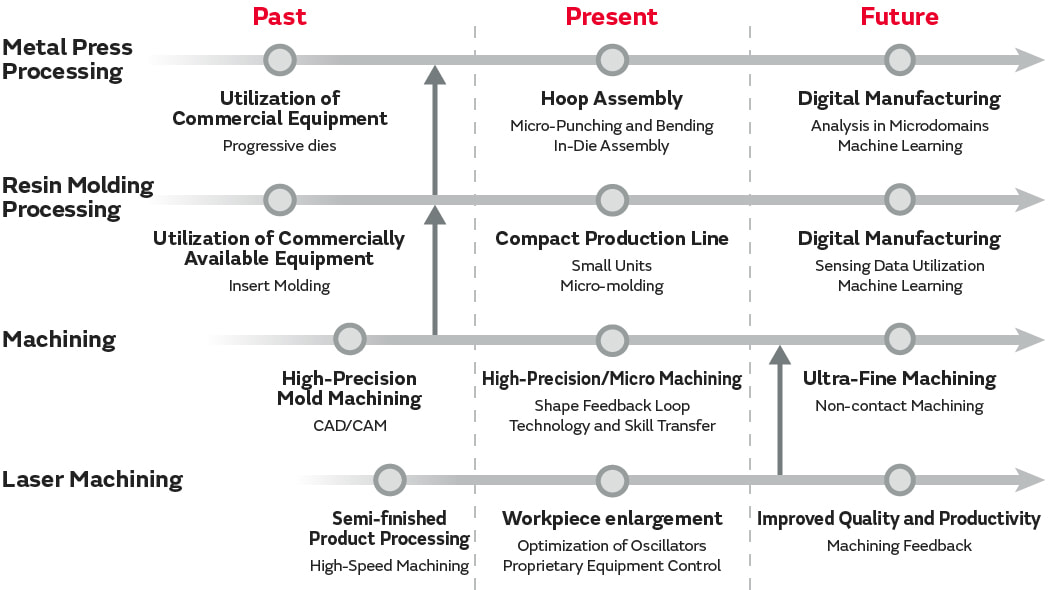
The core technological elements underpinning the evolution of Murata's precision machining technology.

Application examples for this technology

This technology is applied to Murata's products and their production processes, from research and development through mass production.

Examples of Precision Processing Technology Application ~Product Introduction~

Technology