Production Technology Thin Film and Microfabrication Technology

Thin Film and Microfabrication Technology icon

Summary

  • General thin film and microfabrication technology combines multiple processes—such as thin film deposition via vapor deposition or sputtering, photolithography, and dry or wet etching—to form intricate patterns on substrates.
  • Murata's thin film and microfabrication technology excels in controlling the microstructures within electronic components with nano-level accuracy of processing, maximizing the inherent properties of functional materials such as piezoelectric materials, dielectrics, and semiconductors.
  • Murata's thin film and microfabrication technology is utilized in the production of diverse electronic components, including SAW devices, MEMS inertial sensors, and silicon capacitors.
    It contributes to achieving miniaturization and high performance in electronic components.
  • Thin film and microfabrication technology, capable of forming microstructures with high accuracy of processing, is one of the key process technologies supporting the evolution of electronic components for a wide range of applications, including mobile devices, automobiles, and IoT.

Murata's Thin Film and Microfabrication Technology

Technical Explanation

Murata's thin film and microfabrication technology controls the microstructures within electronic components with nano-level accuracy of processing to maximize the inherent properties of functional materials such as piezoelectric, dielectric, and semiconductor materials.

This technology consists of two pillars: material deposition technology and microstructure processing technology.

Deposition technology: This technology involves selecting and combining methods such as vacuum deposition, sputtering, and CVD according to application requirements to form thin films with excellent uniformity, adhesion, and crystallinity.
This advanced deposition control maximizes the inherent functions of piezoelectric and semiconductor materials, achieving high performance in Communications and sensing applications.

The processing technology: This technology utilizes photolithography, etching, wafer bonding, deep trenching, and other techniques to form complex sub-micron-scale stacked structures and three-dimensional architectures.
This enables the integration of sophisticated electrode layouts and three-dimensional mechanical structures within components, achieving miniaturization while keeping or enhancing performance.

Furthermore, by combining these technologies with proprietary in-house developed processes, we realize intricate internal structures that are difficult for competitors to achieve.
This approach contributes to achieving both higher performance and miniaturization in electronic components.
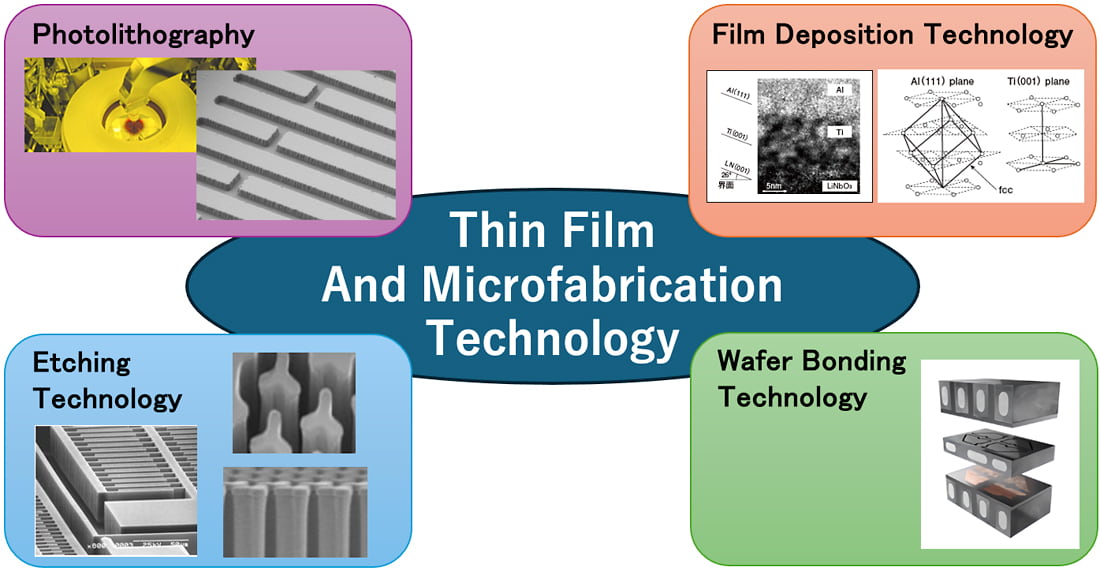
Figure: Murata's Thin Film and Microfabrication Technology
Murata's Thin Film and Microfabrication Technology

Technological Strengths

Murata's strength in thin-film and microfabrication technology lies in its integrated development system. This system tightly links electronic component design technology, process technology utilizing thin-film and microfabrication, and structural analysis technology. Process integration serves as the core, enabling overall optimization.
We combine existing processes cultivated through diverse electronic component production with newly developed proprietary processes, leveraging existing equipment across the board.
This enables rapid reconfiguration of production flows tailored to specific applications and materials, achieving both speed and cost-effectiveness in new product development.

Figure: Integrated Development System for Thin Film and Microfabrication Technology
Integrated Development System for Thin Film and Microfabrication Technology

Furthermore, to maximize the characteristics required of electronic components, process optimization capabilities that unlock the latent potential of thin-film materials are essential.
Murata meticulously designs deposition and processing conditions for each material, comprehensively controlling film thickness, composition, crystal orientation, internal stress, and interfacial adhesion.
Specifically, deposition methods such as vapor deposition, sputtering, CVD, and ALD are appropriately selected based on the ingredient and application.
Furthermore, we combine pre-treatment washing, surface activation, and thermal processes like annealing in optimal sequences and conditions.
This approach achieves high levels of crystallinity and surface quality, enabling the stable expression of the electrical and mechanical properties required for electronic components.
This technology maximizes the inherent functions of materials like piezoelectric and semiconductor materials, ensuring high performance and reliability even in sub-micron-scale structures.

Figure: Realization of Electrical and Mechanical Properties through Process Condition Optimization
Realization of Electrical and Mechanical Properties through Process Condition Optimization

Technological Advancement

Murata's thin film and microfabrication technology has evolved not merely to pursue miniaturization, but to realize the functionality of electronic components that meet market needs.
Starting with SAW filters in the initial stages, we established foundational technologies that enhance frequency characteristic stability and power handling capability through high-precision patterning techniques and control of thin film material crystal structures.
In recent years, we have acquired process engineering for inertial MEMS sensors centered on 3D machining and for silicon capacitors utilizing conformal dielectric film formation.
This has expanded the diversity of our technology portfolio.
The three pillars—SAW filters, MEMS sensors, and silicon capacitors—are driving the breadth of our technology.
We have achieved step-by-step evolution starting with the introduction of new materials and process enhancements.

Currently, device design, process technology, and analytical technology collaborate, combining existing technologies with new proprietary processes centered on process integration.
We have established a system capable of rapidly reconfiguring the optimal production flow for each product.
Moving forward, we will promote the further integration of dissimilar materials and processes, along with new material deposition technology development.
We will continuously enhance our competitiveness while responding to evolving market demands.

Figure: Evolution of Thin Film and Microfabrication Technology
Evolution of Thin Film and Microfabrication Technology

Application examples for this technology

*Link to the product information site.

See here for related Murata technologies.

Examples of Thin Film and Microfabrication Technology Application ~Product Introduction~

Technology