Product Design Technology Connectivity Component Design Technology

Connectivity Component Design Technology icon

Summary

  • General connectivity component design technology refers to radio wave propagation technologies that achieve wireless performance defined by public standards.
  • Murata’s connectivity component design technology consists of high frequency device design and manufacturing technologies, together with modularization technologies that integrate communication functions.
    These technologies incorporate key elemental capabilities such as advanced simulation techniques, evaluation and analysis methods, and packaging technologies.
  • The strengths of Murata’s connectivity component design technology lie in superior device characteristics achieved through proprietary technologies, including high performance RF device design using GaAs and SOI (Silicon On Insulator), as well as optimized thin film electrode structures.
    Another major advantage is Murata’s ability to comprehensively address customer challenges through module miniaturization enabled by LTCC material technology and flexible software support.
  • As connectivity component design technologies continues to evolve, Murata has steadily advanced its high frequency device design and manufacturing technologies, module miniaturization technologies, and software capabilities.
    Going forward, Murata will continue to leverage digital technologies to contribute to further societal development.

Murata's Connectivity Component Design Technology

Technical Explanation

Murata’s connectivity component design technology encompasses both modularization technologies that integrate communication functions into modules and high frequency device design and manufacturing technologies.
These technologies include electromagnetic field simulation and signal evaluation and analysis technologies for achieving the communication performance required across all frequency bands.
In addition, thermal and stress simulation technologies and packaging technologies are included to realize compact structures and ease of handling for customers.
In recent years, demand for utilizing millimeter wave frequency bands exceeding 60 GHz has increased significantly.
As a result, these technologies play a critical role in high frequency circuit design and overall product structural design, including antennas.
Furthermore, Murata’s modularization technologies also incorporate software technologies that enable communication functions to operate seamlessly within customer devices.

Connectivity Components and Their Core Technologies 1
Connectivity Components and Their Core Technologies 2

Connectivity Components and Their Core Technologies

Technological Strengths

Murata’s strength in connectivity component design technology lies in its ability to solve customer challenges by combining high performance device design with module design that fully leverages those device characteristics, supporting customer needs for “connecting” and “staying connected.”
In device design, Murata applies GaAs based technologies to realize power amplifiers with excellent linearity, and SOI technologies to realize low-noise amplifiers and advanced digital circuit integration.
In addition, optimized thin film electrode structure design achieves superior filter characteristics, resulting in high performance RF devices.

In module design, Murata leverages LTCC material technologies cultivated over many years, together with double sided mounting and low profile technologies, as key strengths.
The availability of in house devices that allow fine performance optimization is another important advantage.
Moreover, Murata combines not only hardware technologies but also regulatory compliance and certification technologies, as well as software technologies such as communication drivers.
Through this comprehensive approach, Murata solves customer challenges in an integrated manner.

Dual-sided Mounting Technology and Antenna Design Technology

Technological Advancement

Murata’s connectivity component design technology began with the supply of RF products and antenna products, and later expanded into integrated connectivity module design.
Murata developed Wi-FiTM and Bluetooth® modules, and to enable their use in compact devices such as smartphones and wearable products, enhanced the precision of fine pitch mounting technologies and double sided processing, continuously refining packaging processes.
In response to the growing demand for IoT, Murata added modules supporting LPWA (Low Power Wide Area) and cellular communications, strengthening capabilities in low power consumption and long range communication technologies.

In recent years, the rapid increase in data transmission capacity has driven demand for millimeter wave compatible devices.
Because millimeter wave frequencies have extremely short wavelengths, conventional microwave band design approaches are no longer sufficient.
To address this, Murata has advanced simulation and evaluation technologies, accumulating new knowledge and expertise while adapting to ongoing technological evolution.

Looking ahead, Murata will continue to pursue further miniaturization and performance optimization, while preparing for increasingly diverse wireless communication needs.
By advancing software technologies and regulatory certification technologies, and by effectively applying Digital ET (Envelope Tracking) and XBAR technologies, Murata aims to contribute to a new wireless communication society enabled by 5G and 6G.
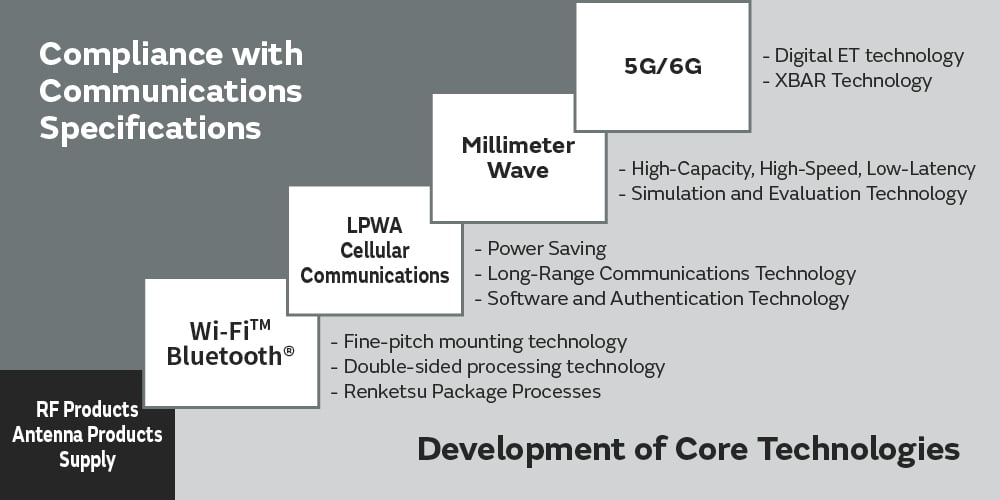
Development of core technologies for connectivity component design to support evolving communication specifications

Application examples for this technology

*Link to the product information site.

Examples of Connectivity Component Design Technology Application ~Product Introduction~

Technology