Product Design Technology Sensing Design Technology

Sensing Design Technology icon

Summary

  • General sensing design technology is a design discipline that detects physical, chemical, and biological phenomena, converts them into electrical signals, and enables measurement and analysis. This technology integrates sensor element selection, structural design, signal processing circuit design, noise countermeasures, and adaptation to environmental conditions to achieve the required measurement accuracy, response speed, and stability.
  • Murata’s sensing design technology features a broad lineup that includes temperature sensors (NTC thermistors), MEMS sensors, and ultrasonic sensors. It integrates material design, structural design, and signal processing technologies optimized for the specific characteristics of each sensor.
  • The key strength of Murata’s sensing design technology lies in its comprehensive capability to consistently optimize everything in-house, from material design and structural design to electronic circuit design and software design.
  • For temperature sensors, Murata achieves high sensitivity, high reliability, and miniaturization by optimizing material composition, firing processes, and packaging technologies. For MEMS sensors, Murata fuses microfabrication processes, encapsulation technologies, and low-noise design techniques to realize multi-parameter detection and high sensitivity.

Murata's Sensing Design Technology

Technical Explanation

Murata’s sensing design technology addresses diverse sensing needs by integrating and applying elemental technologies optimized for each sensor type across a broad lineup that includes temperature sensors (NTC thermistors), MEMS sensors, and ultrasonic sensors.

Technical Elements of Temperature Sensors (NTC Thermistors)
  • Material Design Technology: Murata precisely controls the composition of semiconductor ceramic materials, primarily manganese oxide and cobalt oxide, to optimize the temperature coefficient. This enables high-sensitivity temperature response and supports a diverse product lineup that combines environmental resistance, high accuracy, and long service life tailored to each application.
  • Packaging Design Technology: Murata offers ultra-compact chip types and resin-molded types. While advancing high-density wiring and thin-profile designs, these packages also meet the stringent environmental resistance requirements of automotive and industrial applications.
Technical Elements of MEMS Sensors
  • Structural Design Technology: Murata designs submicron-precision structures to realize compact, high-sensitivity mechanical elements such as accelerometers and gyroscope sensors. This is achieved by using advanced microfabrication processes, including photolithography, etching, and thin-film deposition, to form high-precision micromechanical structures on silicon substrates.
  • Signal Processing Technology: Murata achieves high-level integration with ASICs (Application-Specific Integrated Circuits) that precisely process sensing signals from MEMS elements. By integrating noise reduction, signal amplification, temperature compensation, and digital conversion, Murata enhances overall sensor performance while also achieving space savings.
Optimizing, integrating, and applying elemental technologies for each sensing need

Technological Strengths

Murata’s strength in sensing design technology lies in its comprehensive capability to consistently optimize material design, structural design, electronic circuit design, and software design within the company.

Strengths of Temperature Sensor (NTC Thermistor) Design Technology

This technology is built on extensive expertise cultivated through the development of multilayer ceramic capacitors. By performing material mixing, composition control, and firing profile optimization for semiconductor ceramic materials entirely in-house, Murata achieves diverse and high-quality material designs. By further integrating advanced manufacturing technologies, Murata provides thermistors optimized for specific applications and required characteristics, enabling high-sensitivity temperature detection and enhanced reliability.
In addition, for automotive, industrial, and medical applications, Murata improves temperature measurement accuracy by offering optimal mounting position solutions based on extensive experimental data and proprietary simulation technologies. These solutions are derived from detailed temperature distribution measurements using MOSFETs and electronic substrates, together with thermal analysis verification using CAE software such as Femtet.
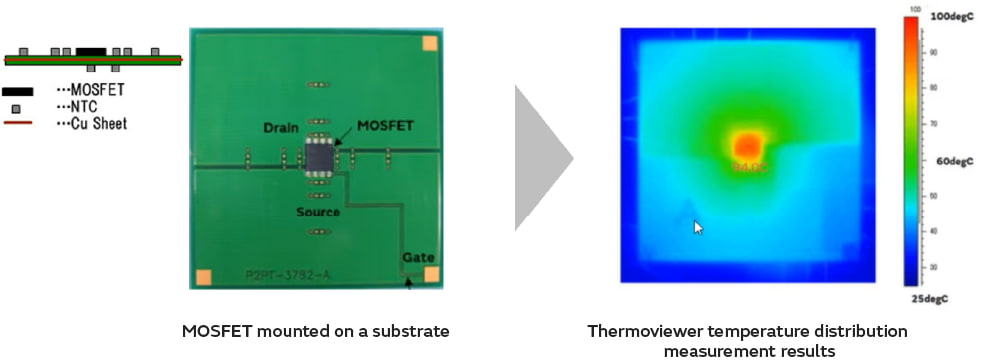
Temperature distribution measurement of MOSFET
Strengths of MEMS Sensor Design Technology

The core strength of Murata’s MEMS sensor design lies in the integration of microfabrication technology and advanced signal processing technology. In particular, microfabrication technologies capable of forming high-precision microstructures at the 1–2 µm level enable compact, high-sensitivity, and high-performance devices. By combining these structures with advanced signal processing technologies that suppress variations and noise caused by temperature changes and external stress, Murata ensures stable performance even under harsh environments such as automotive, industrial equipment, and social infrastructure applications. This robust design enables Murata’s MEMS sensors to provide highly reliable and accurate measurements across diverse applications. Microfabrication techniques enable the formation of high-precision microstructures at the 1–2 µm (micrometer) level, realizing compact, high-sensitivity, and high-performance devices. By combining these structures with advanced signal processing technologies that suppress characteristic variations and noise caused by temperature changes and external stress, Murata ensures stable performance even under harsh operating conditions.

This comprehensive capability for consistent optimization forms the core of Murata’s sensing design technology.
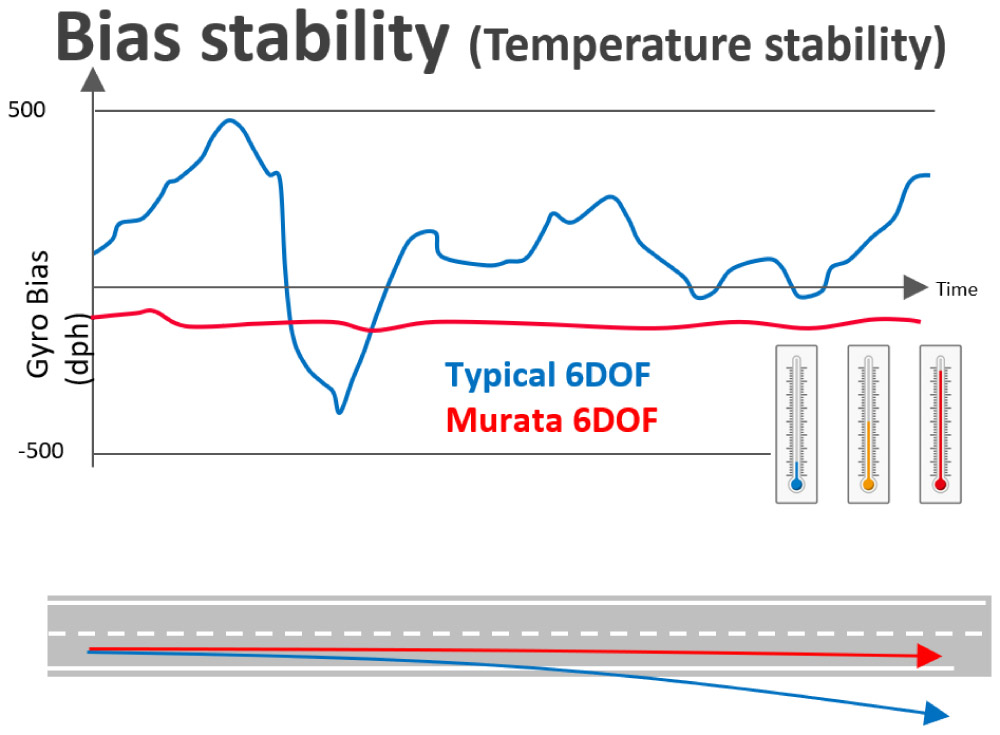
Stability of MEMS Sensor Temperature Characteristics

Technological Evolution

Evolution of Temperature Sensor (NTC Thermistor) Design Technology

Murata began research and development of thermistor materials at an early stage. Based on manganese oxide– and cobalt oxide–based NTC thermistors, Murata established technologies to stabilize temperature detection characteristics. Through optimization of firing processes and material composition, Murata achieved higher sensitivity and improved linearity. In addition, by establishing ceramic forming technologies and electrode formation technologies suitable for mass production, Murata balances cost competitiveness with stable performance.
Murata has also advanced packaging technologies to improve heat resistance, enabling thermistors that are robust against environmental changes. Proprietary molding materials significantly enhance reliability in demanding environments such as automotive and medical equipment. In addition, Murata has introduced precision modeling technologies using design software to expand the temperature detection range and reduce measurement error.
To support the evolution of edge devices, Murata has also developed compact and thin thermistors.

The Birth of the Chip Type Temperature Sensor (Thermistor) Through the Fusion of Material Technology and Capacitors
Evolution of MEMS Sensor Design Technology

Murata has pursued micromachining technology from an early stage, establishing processing techniques for forming intricate mechanical structures on silicon substrates. Murata has also successfully commercialized integrated MEMS sensors capable of multi-axis detection, such as accelerometer–gyroscope hybrid sensors.
Murata has also successfully commercialized integrated MEMS sensors capable of multi-axis detection, such as accelerometer–gyroscope hybrid sensors.

Looking ahead, Murata will continue to drive technological innovation that directly addresses future challenges, including renewable energy, energy harvesting, advanced medical sensing, and autonomous driving support. Sensors are no longer just measurement devices; they play a vital role in safely connecting people and infrastructure.

Evolution of Advanced Integration of MEMS Sensors and ASICs

Application examples for this technology

*Link to the product information site.

See here for related Murata technologies.

Examples of Sensing Design Technology Application ~Product Introduction~

Technology