Production Technology Green Sheet Process Technology

Green Sheet Process Technology icon

Summary

  • Generally, green sheet process technology refers to a series of technologies for processing ceramic green sheets, which are thin, unfired ceramic sheets containing ceramic powder and organic binders.
  • Murata's green sheet process technology consists of a wide range of technologies, including slurry mixing and dispersion, sheet forming, internal electrode printing, sheet lamination, and pressing, and is used in important initial processes in the manufacture of multilayer ceramic capacitors and other products.
  • This green sheet process technology is applied to a wide range of products, including multilayer ceramic capacitors, EMI (electromagnetic interference) countermeasure products, and thermistors, and has contributed to the realization of the world's smallest 016008 size (0.16 mm (millimeters) × 0.08 mm).
  • In addition to the green sheet process, various core technologies such as ceramic and metal material technology, heat treatment, plating, and computational science are utilized in the manufacture of multilayer ceramic capacitors.

Murata's Green Sheet Process Technology

Technical Explanation

Murata's green sheet process technology is a complex process involving numerous interconnected steps, including slurry mixing and dispersion, sheet forming, internal electrode printing, sheet lamination, and pressing.

First, ceramic powder (mainly BaTiO3 (barium titanate) and ferrite) is mixed with a binder and solvent to form a paste. This paste is spread thinly and evenly, then dried to create a green sheet (unfired ceramic sheet). Metal materials such as Ni (nickel), which will become the internal electrodes, are precisely formed on the green sheet using printing technology. Next, the required number of sheets are stacked, pressed, and cut to create a multilayer structure.

This structure consists of ceramic sheets and metal electrodes stacked alternately in multilayer ceramic capacitors, with the total area determining the capacitance.

In order to achieve high capacitance in an extremely small size, it is essential to form the sheets and electrodes as thin as possible and to stack them without misalignment through precise process control. Murata's strength lies in its ability to achieve all of this at a high level.
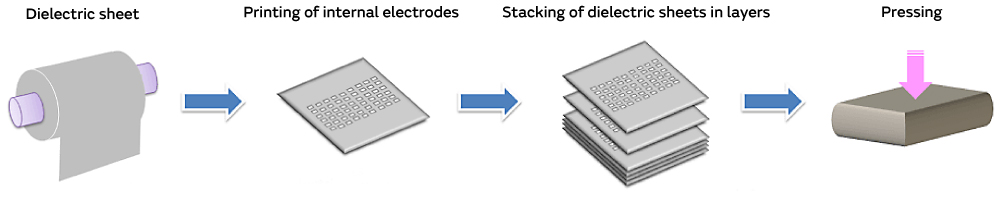
Green sheet process flow

Source of inserted image: Basics of capacitors [Lesson 3] How multilayer ceramic capacitors are madeOpen in New Window

Technological Strengths

The strength of Murata's Green Sheet process technology lies in its ability to realize cutting-edge electronic components that require both high performance and miniaturization, achieved through the sophisticated coordination of not only each processing technology, but also material design and product design. This contributes to increased design freedom and improved mounting density.

Specifically, in sheet forming technology, nano-sized ceramic materials can be distributed densely and uniformly to form thin sheets without defects in a stable manner. In internal electrode printing technology, fine electrode patterns with widths of tens of microns (1 micron = 1/1000 mm) can be printed on green sheets with high precision and reproducibility. In sheet stacking technology, extremely thin, homogeneous ceramic sheets can be stacked without damage and with almost no misalignment. All of these are achieved not solely through the green sheet process, but through coordination with material design and product design according to material characteristics and product specifications.

Through this comprehensive approach, Murata is able to offer products that simultaneously satisfy the three requirements of performance, reliability, and miniaturization in a wide range of electronic components, including some of the world's smallest multilayer ceramic capacitors.

Thinning of Green Sheets

Source of inserted image: Advantages of Murata CapacitorsOpen in New Window

Technological Advancement

Murata's green sheet process technology has evolved in line with the miniaturization and increased performance of electronic components, as well as the expansion of production volumes.

In the past, we focused on binder composition and ceramic powder particle size control to achieve uniform thin film molding, thereby advancing our sheet molding technology. In internal electrode printing technology, we have improved printing accuracy and reliability by repeatedly refining high-precision printing mechanisms and pastes to form fine and thin electrode patterns. Furthermore, in sheet lamination technology, we have made detailed improvements in alignment accuracy and material design to accurately stack thin, delicate sheets without damage.

In recent years, we have deepened these fundamental technologies and are also advancing material design and process technology to achieve high rated voltages, high temperature resistance, and narrow deviation capacitance. By holistically refining these elemental technologies, Murata continues to pursue both reliability and performance. This accumulation of technology forms the foundation supporting the future electronic society.

Moving forward, in addition to current initiatives, we will actively leverage DX (Digital Transformation) and other approaches to further advance our integration capabilities. This will enable us to create unique products that transcend the extension of conventional technologies, delivering new value to the market.

Figure: High-Precision Lamination of Thin Green Sheets
High-Precision Lamination of Thin Green Sheets

Source of inserted image: Advantages of Murata CapacitorsOpen in New Window

See here for related Murata technologies.

Examples of Green Sheet Process Technology Application ~Product Introduction~

Technology