Examples of Technology Application ~Product Introduction~ The Evolution of Inertial Sensors Supported by Murata's Technical Capabilities

Key Technologies Used: Sensing Design Technology, Micro Mechatronics Design Technology, Thin Film and Microfabrication Technology, Simulation Technology

Image: SCH1600 Series Appearance

Summary

  • Murata's inertial sensors feature industry-leading precision and low-noise performance, achieved through advanced MEMS (Micro-Electro-Mechanical Systems) device design technology and microfabrication techniques.
  • Products supported by these technological capabilities are utilized in a wide range of applications, including automotive and industrial fields where high precision and reliability are essential. Particular strengths include robust designs that deliver stable performance even in harsh environments, along with circuit design and packaging technologies that minimize characteristic variations and noise caused by temperature and external stresses.
  • In recent years, Murata has pursued continuous technological innovation, including the evolution to combo sensors combining 3-axis accelerometers and 3-axis gyroscopes, significant improvements in noise characteristics, and miniaturization.

Murata's Inertial Sensors

Product Description

Murata's inertial sensors play an important role in supporting equipment control, stabilization, and position estimation.
Based on MEMS technology, they detect changes in motion and orientation, such as acceleration and angular velocity, with high precision and stability.

The package incorporates a sensing element fabricated using MEMS technology and an ASIC (Application-Specific Integrated Circuit) that performs signal processing.
The sensing element is fabricated using microfabrication techniques on a silicon substrate. When subjected to inertial forces, part of the structure displaces, generating a change in capacitance that is output as an electrical signal.
Accelerometers employ a spring-mass model structure, while angular velocity sensors utilize the Coriolis force detection principle.

The technology for stable production of element structures approximately 2 mm square in size, combined with proprietary packaging technology, achieves high precision and high reliability for the sensors.
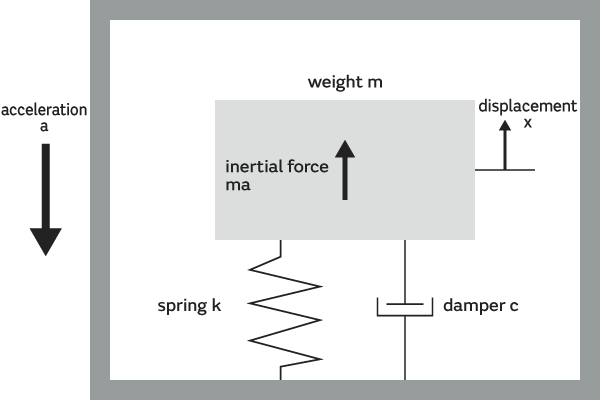
Figure: Schematic Diagram of Acceleration Detection Principle
Schematic Diagram of Acceleration Detection Principle
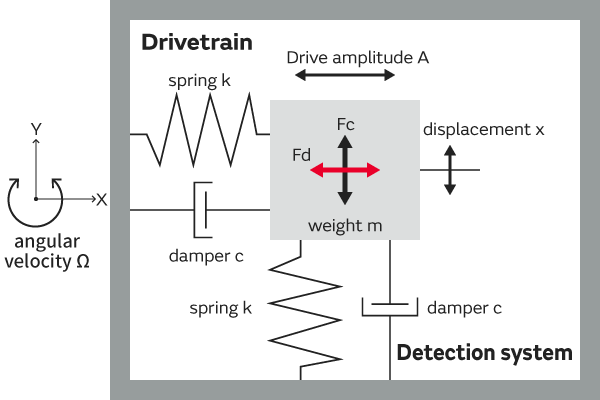
Figure: Angular Velocity Detection Principle Schematic Diagram
Angular Velocity Detection Principle Schematic Diagram

Product Strengths

The greatest strength of Murata's inertial sensors is their industry-leading precision, achieved through advanced MEMS element design and fabrication technologies.

The latest SCH1600 series achieves an offset temperature characteristic of ±2 mg (Typ.) for accelerometers and an angular random walk characteristic of 0.05 deg/√Hz (Typ.) for angular rate sensors. This high precision is achieved through a combination of element design and microfabrication technology, along with circuit design and packaging technology that minimizes characteristic variations and noise caused by temperature and external stress.

Furthermore, for automotive applications, the design meets ASIL-B(D) level functional safety requirements. This ensures compliance with stringent safety standards, enabling reliable use even in life-critical applications.

Figure: Allan variance characteristic plot of a gyro sensor
Allan variance characteristic plot of a gyro sensor

Product Evolution

Murata's inertial sensors continue to advance in miniaturization and high precision to meet the demands of the times.

Ten years ago, combo sensors featuring a 3-axis accelerometer plus a 1-axis gyroscope were mainstream.
In recent years, the spread of autonomous driving technologies and related applications has driven demand for 3-axis gyros. Consequently, inertial sensors integrating a 3-axis accelerometer and a 3-axis gyroscope into a single package have been added to the lineup.
Furthermore, we have achieved enhanced accuracy in the gyro's angle random walk (ARW) performance metric to meet the high-precision self-localization requirements of ADAS functions.

Compared to the previous generation 6-axis sensors, the SCHA600 series (12.1 × 19.7 × 4.6mm), the latest SCH1600 series (11.8 × 13.4 × 2.9mm) reduces volume by approximately 58%, significantly improving mounting efficiency.

Figure: Murata Inertial Sensor Lineup and Evolution Concept Diagram
Murata Inertial Sensor Lineup and Evolution Concept Diagram

Product Applications

Murata's inertial sensors are widely utilized in the automotive field for ESC (Electronic Stability Control), fall/rollover detection systems, car navigation devices, and the self-localization function of ADAS.
The reason they are well-suited for automotive applications is their ability to detect angular velocity and acceleration with high precision, significantly contributing to vehicle control and safety functions.

For example, in ESC, the angular velocity detected by the gyro sensor is compared with the angular velocity estimated from the steering wheel angle sensor and odometer to determine skid conditions. In car navigation and ADAS, map matching is performed by combining yaw rate and distance traveled information to supplement GNSS position data.
Furthermore, it is utilized in diverse fields such as fall detection, airbag deployment control, attitude control for industrial equipment like construction machinery and drones, and structural deformation detection.

Check the product information site for product specifications, etc.

Other Practical Examples ~Product Introduction~

Technology